If you have noticed aches or pains in your low back at some point over the past few months, you are not alone. This year has been filled with all sorts of changes, from transitioning to working from home to changing how we exercise or stay active. Despite our best efforts to create a proper work from home space or exercise routine, back pain has found its way into many of our lives.
Strengthening your core and improving your posture can create a huge impact on reducing those low back aches and pains. Our spine is made up of several bones (vertebra) that all join together to essentially create a chain. Along with strengthening muscles throughout the core, it is important to help these bones move the way they are designed to move by incorporating spinal mobility exercises. If you are one of the many others that is experiencing new or recurring back pain, give some of these strength and mobility exercises a try.
Strengthening
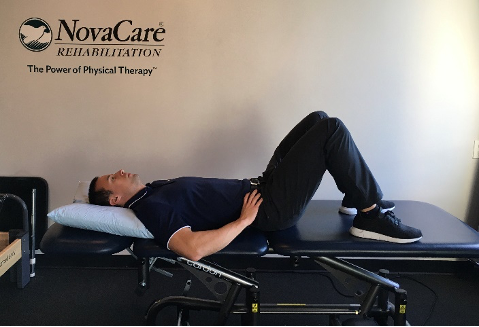
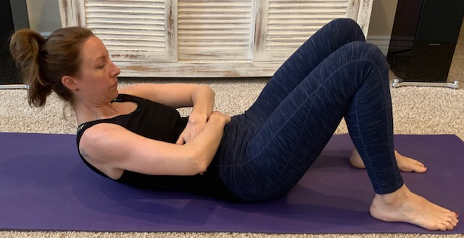
Pelvic Tilts
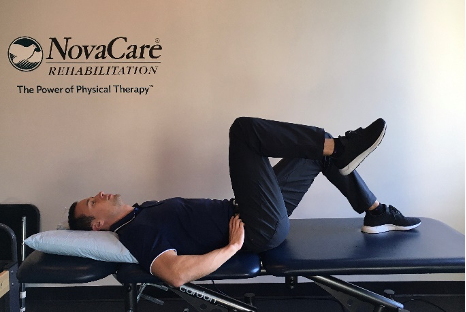
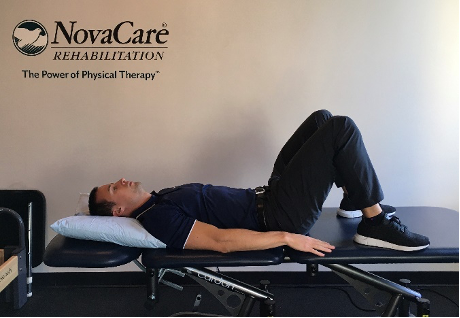
Lie down on your back with your knees bent and feel flat on the floor. Place your hands on your hips to help get a feel for this motion. Squeeze your belly as if you are trying to bring your belly button in toward the ground. Gently exhaling can help to activate this contraction. The goal is to feel your pelvis rotate backward (posterior pelvic tilt). Repeat this for 12-15 repetitions.
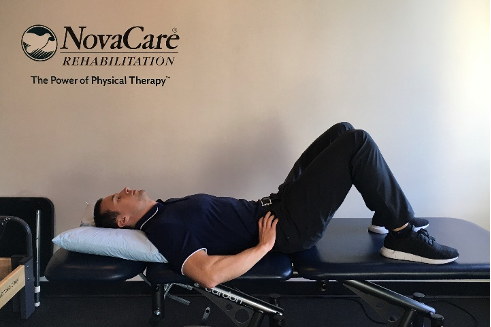
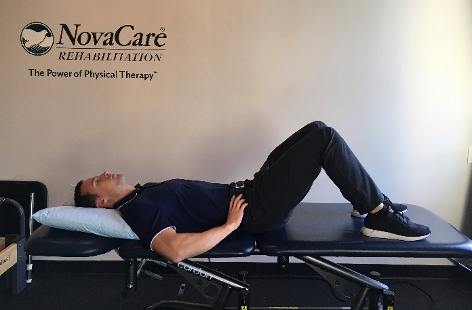
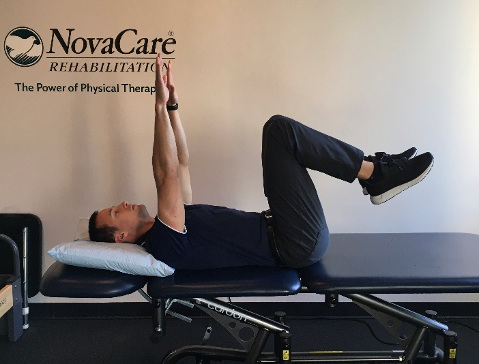
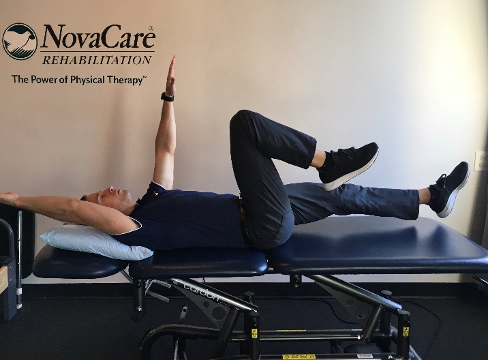
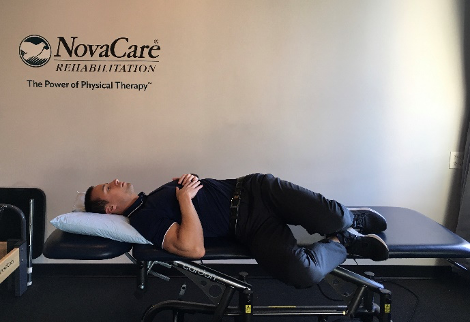
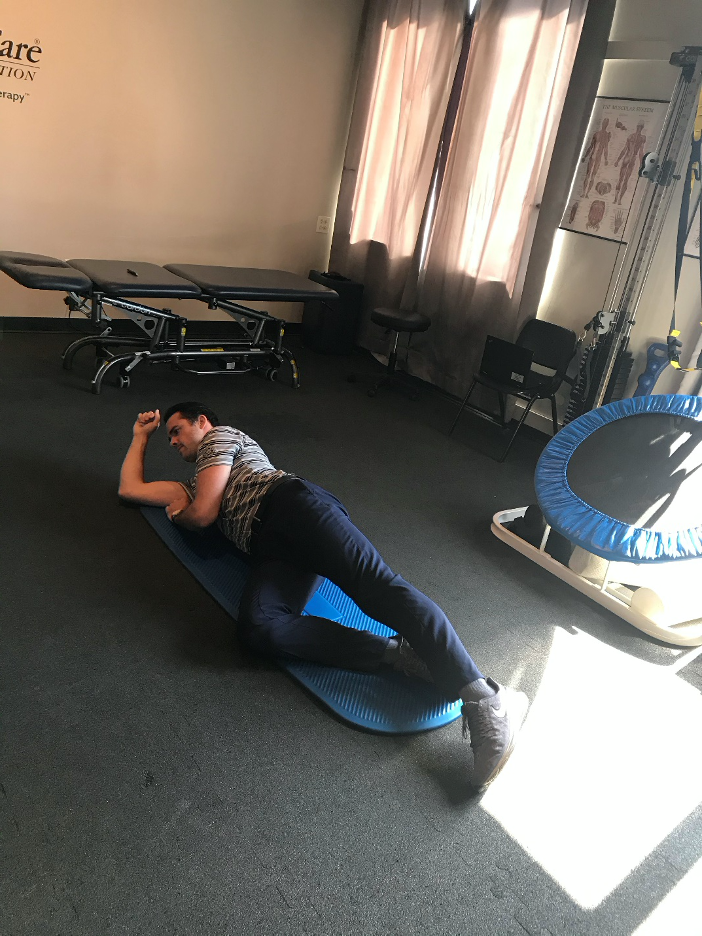
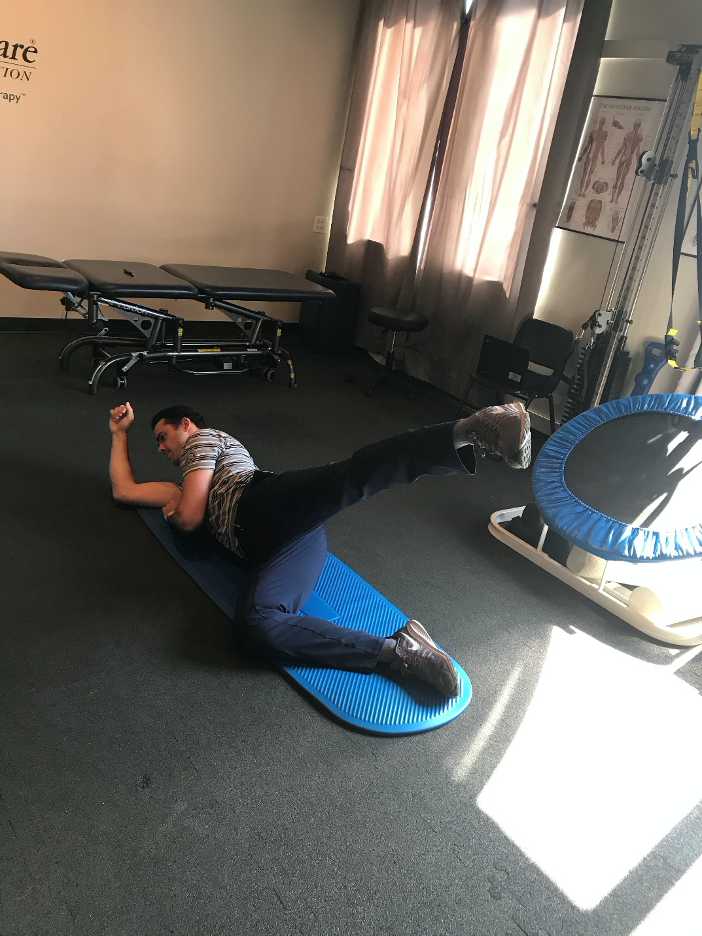
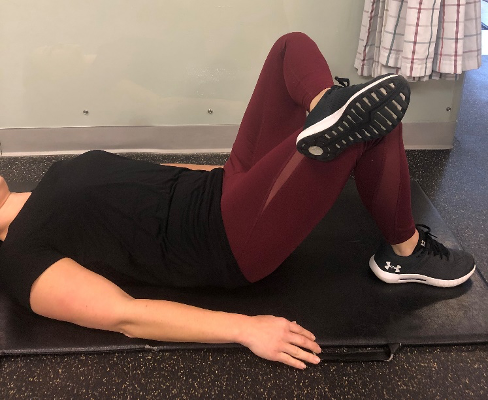
Position yourself the same way as above with the pelvic tilts. Begin with the pelvic tilt and lift one knee toward your chest, then back down. Alternate left and right 20 times. If this is not challenging enough for you, lift both knees at the same time and alternate lowering one leg down to the table as seen below. Perform 20 repetitions.
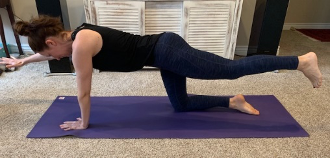
Bird Dogs
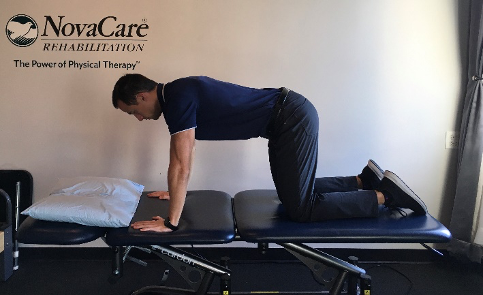
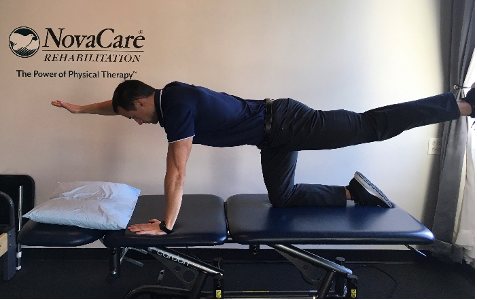
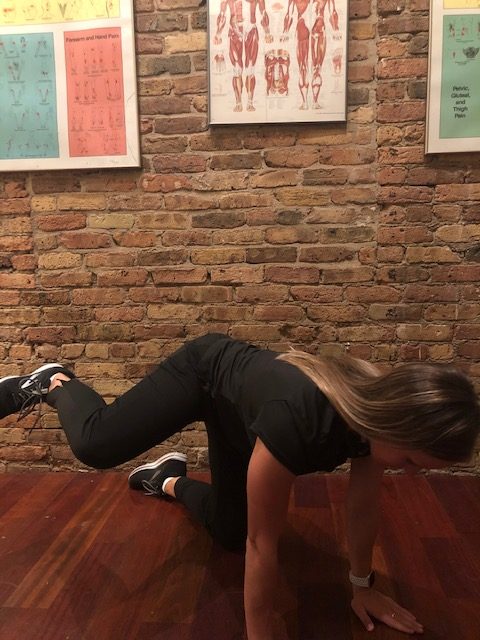
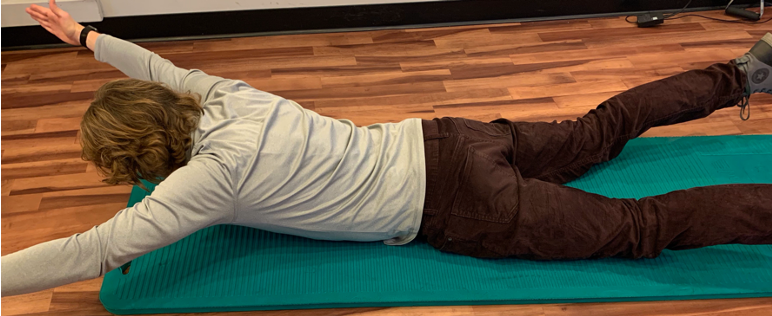
This will target your hip and back extensors as well as help to strengthen your shoulder blades to keep them in a good position throughout the day. On your hands and knees, extend your left arm and right leg simultaneously. Alternate between left arm-right leg and right arm-left leg. Really focus on keeping your hips and low back stable so you aren’t overarching your back or leaning to the side.
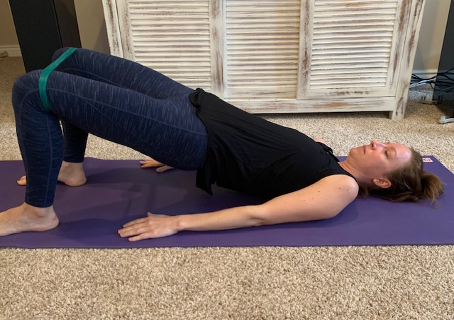
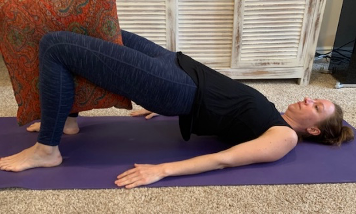
Bridges
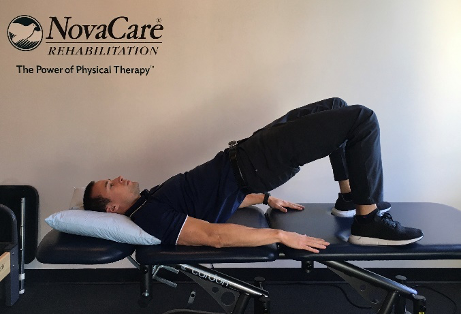
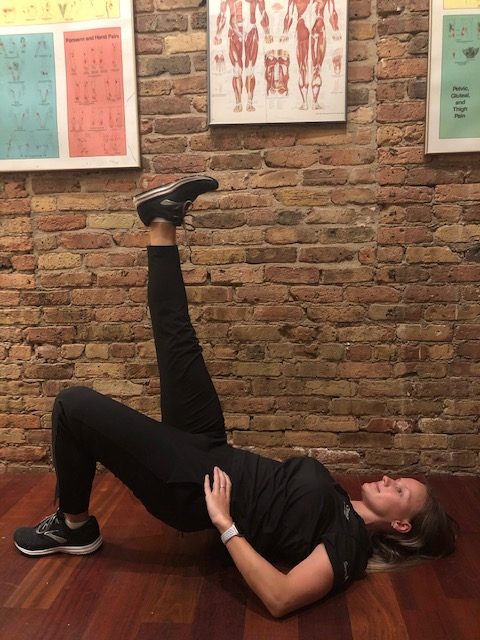
To strengthen your glutes, these hip bridges will be a good starting point. Lie on your back, knees bent and feet flat on the ground. Push through your heels and lift your hips off the ground. Repeat for 12-15 repetitions. For an added challenge, try straightening one leg and lift your hips with only one leg (single leg bridge).
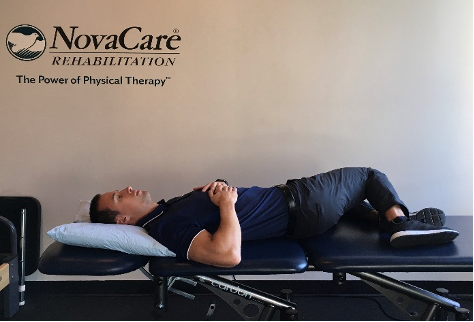
This exercise is great for opening up and loosening your lower back. Start with lying on your back, then bend your knees so your feet are flat on the ground. With your knees together, slowly lower them down to the left and then to the right. Do this back and forth motion about 20 times.
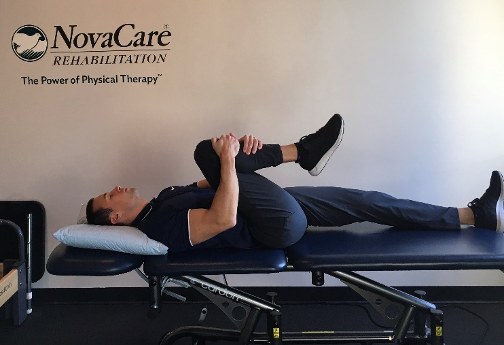
Single Knee To Chest Stretch
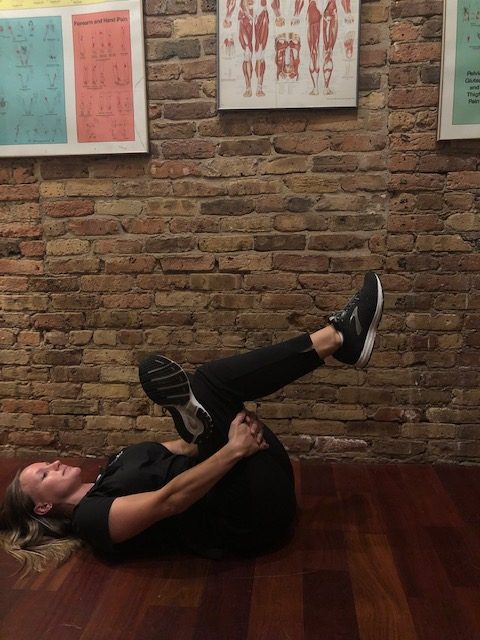
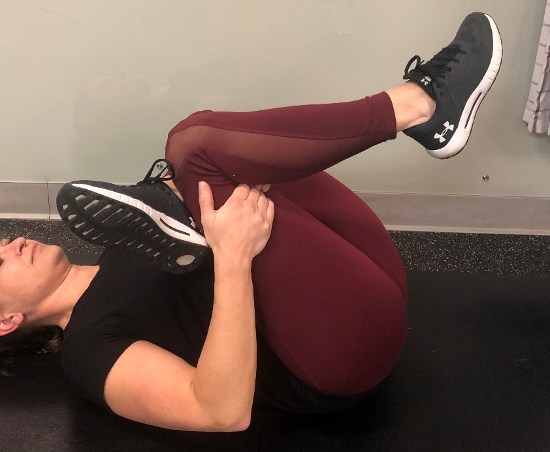
Bring your knee to your chest and hold it there for 30 seconds or more. This will help to stretch those pesky hamstrings. Alternate between left and right for two times on each side.
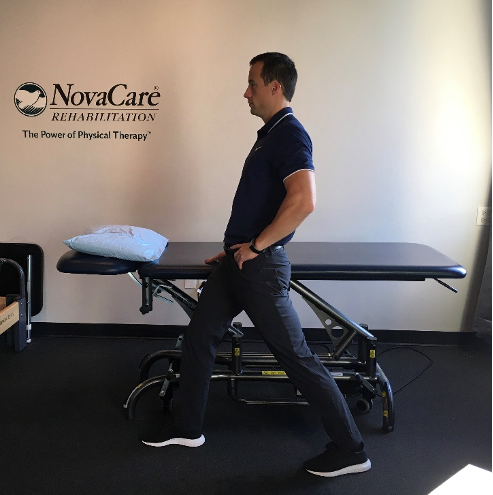
Standing Hip Flexor Stretch
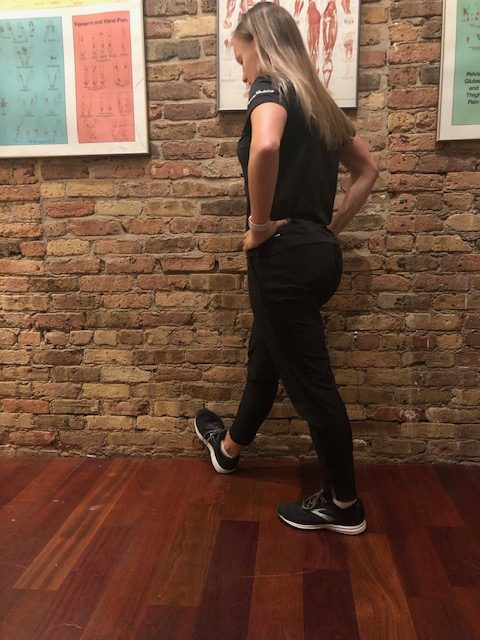
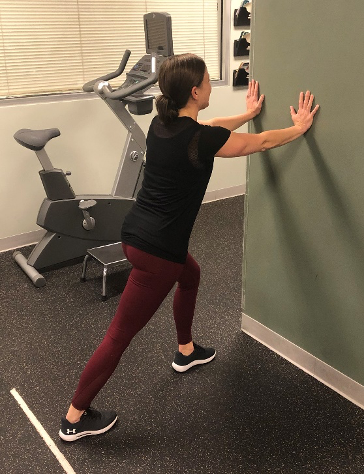
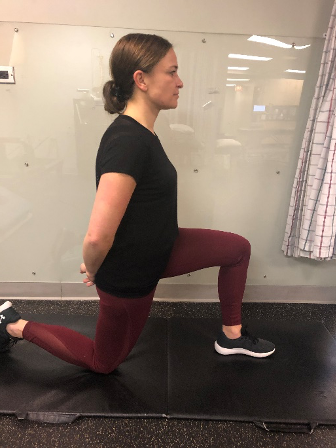
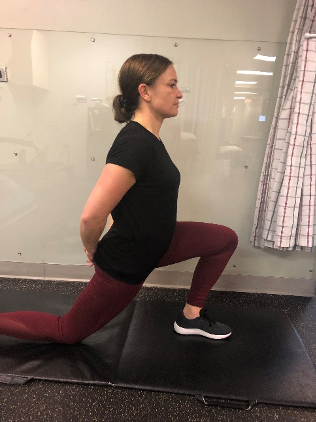
Our hip, pelvis, and low back positioning all have an influence on each other. We have muscles that attach to our lower back and hip, if these muscles become tight or shortened they also affect our posture. Stand with a staggered stance, right leg in front of the left. The left leg will be the one being stretched. Try squeezing your belly button in, this will help to keep your core tight. Shift your weight forward until you feel a stretch in the front of the left hip. Hold in this position for 30 seconds, then switch for the other side.
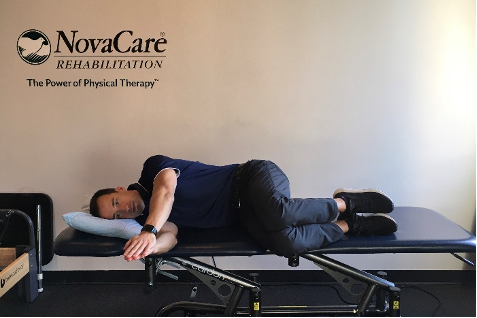
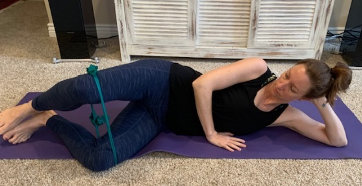
Open Book
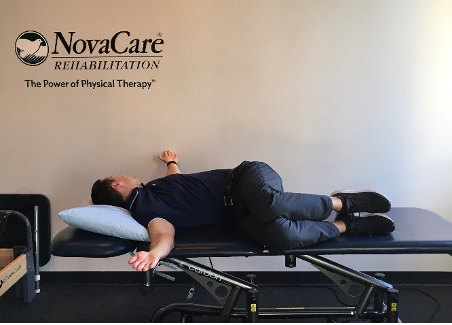
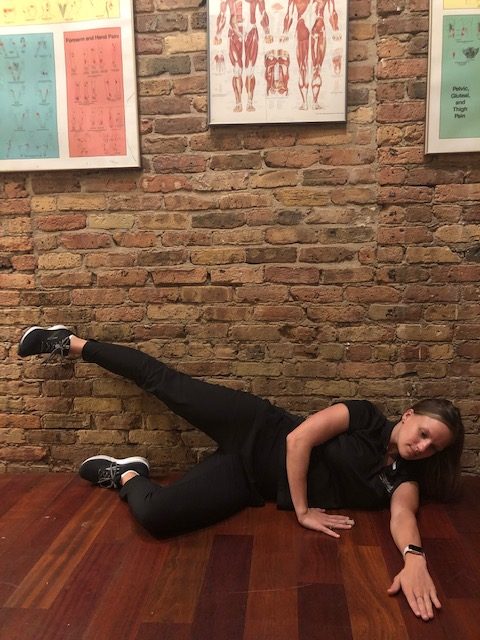
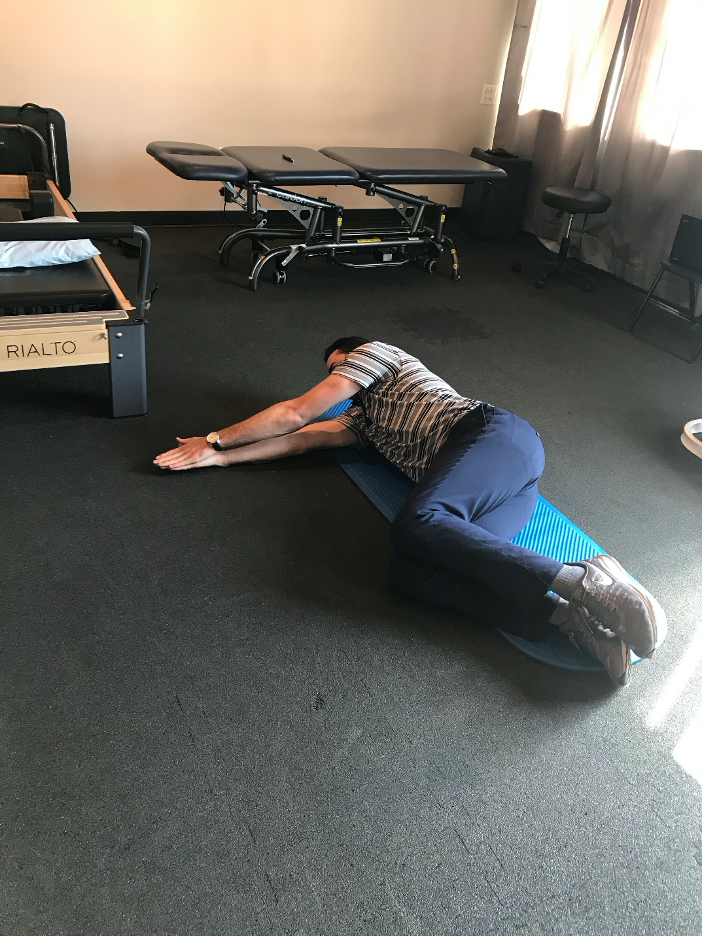
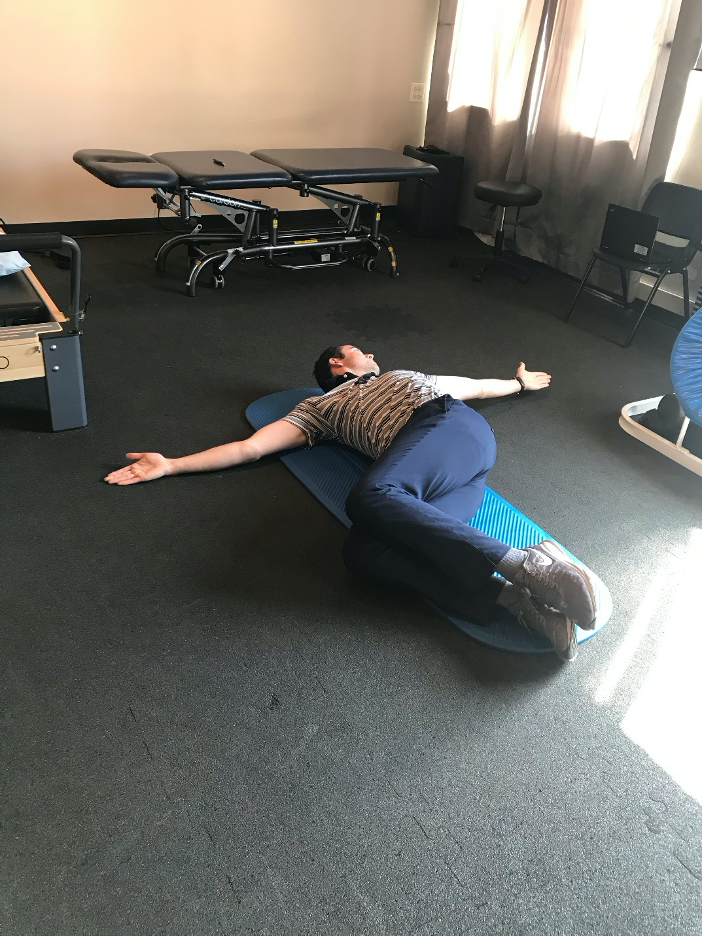
Sitting in a chair for longer periods of time can lead to sitting with less than ideal posture. Rounding through the middle of the back (thoracic spine) for long periods can leave us feeling stiff. This exercise will help to get the thoracic spine moving. Lie on right your side with your knees tucked up towards your chest. With your arm reaching straight out, slowly rotate as far and you comfortably can to the left as if you are trying to touch the left shoulder to the table. Repeat 10 times, then switch to the other side.
Post written by FFC Contributor and Physical Therapist at RUSH Physical Therapy Nate Deblauw.
Nate Deblauw is a physical therapist at our Gold Coast FFC and Rogers Park centers. He earned a Bachelor’s degree in exercise science from Indiana University and a doctorate of physical therapy from Northwestern University. Nate has achieved success in the treatment of orthopaedic and musculoskeletal injuries, running injuries, shoulder pain, low back pain and post-operative rehabilitation. He works with his patients to create an individualized treatment plan to achieve their goals and get them back to their optimal level of function.
https://dev.ffc.com/wp-content/uploads/2020/12/lower-back-pain.png14002280Sydney MeyerSydney Meyer2020-12-21 08:15:252020-12-21 08:15:25Combat Lower Back Pain With These Strengthening and Mobility Moves
FFC Elmhurst General Manager Scott Lewandowski is a 3-time Ironman finisher and 8-time Boston Marathon qualifier. When the statewide mandate for wearing masks while exercising indoors went into effect, Scott decided to try a variety of plastic mask inserts to help him breathe properly during speed interval workouts on the treadmill and high intensity training on the turf. Check out his findings below.
On Tuesday, November 24, I ran 5 miles on the treadmill with a traditional mask, and within 2.5 miles, my mask was soaked and I struggled to breathe. Elite Trainer Brent Yao then introduced me to plastic mask inserts that sit just underneath your mask and help prevent the mask material from clinging to your mouth when sweating and breathing heavily.
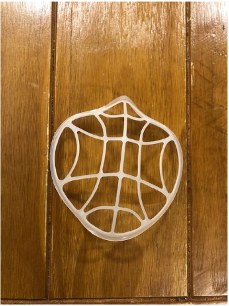
The next day, I ran 5 miles with an insert under my mask. The first insert I tried is the Xinber Silicone Face Inner Support Frame (Large Size). It is 4” tall x 3.6” wide.
I found that it was easier to breathe with the insert, and I completed the distance 4 minutes faster than the previous day. This plastic insert was a bit big but made a huge difference in my performance.
I then decided to purchase additional plastic mask inserts and noticed that there were many different brands and styles. I purchased two other brands to test out for comfort and the Xinber inserts were sold out.
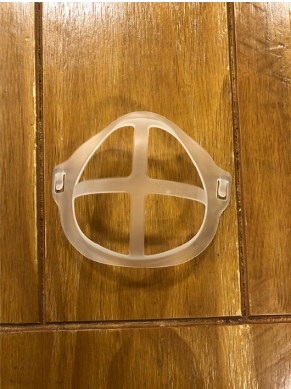
First, I ran 5 miles with the mask insert pictured below. It is the MicroBird Face Mask Bracket. This insert has clips to hook inside pleated masks and is 3.1” tall x 4.1” wide.
The clips intrigued me but my cloth mask does not have pleats to attach the hooks. This mask insert did move around during my run and was a bit annoying.
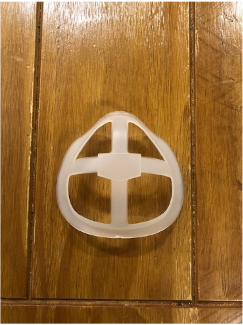
Next, I ran 5 miles with the mask insert pictured below. It is the KDRose 3D Face Inner Bracket. The insert is 3.54” tall x 3.54” wide.
At first, I thought this insert would be too small for my face, but in fact, it fit perfectly and was more comfortable than the Xinber mask.
If you would like to give this mask insert a try, the KDRose 3D Face Inner Bracket will be available for $4 at all FFC locations by December 17.
There are so many insert options available to help you breathe easier while exercising with a mask. I hope my experience helps narrow down the best choice for you. If you have any questions, please feel free to contact me at sl@ffc.com.
Post written by FFC Contributor Scott Lewandowski.
https://dev.ffc.com/wp-content/uploads/2020/12/running-treadmill.png14002280Sydney MeyerSydney Meyer2020-12-14 12:24:012020-12-14 12:24:01Breathe Easy At The Gym With These Plastic Mask Inserts
It’s no secret that 2020 has been a tough year for our local businesses here in Chicago. To spread some cheer this holiday season, we reached out to a few of our fellow small business owners and neighborhood partners to find great gift ideas to share with our members.
As you make your holiday shopping list this year, consider shopping small and supporting these wonderful businesses owned and operated by fellow Chicagoans.
1. Elmhurst Brewing Co.
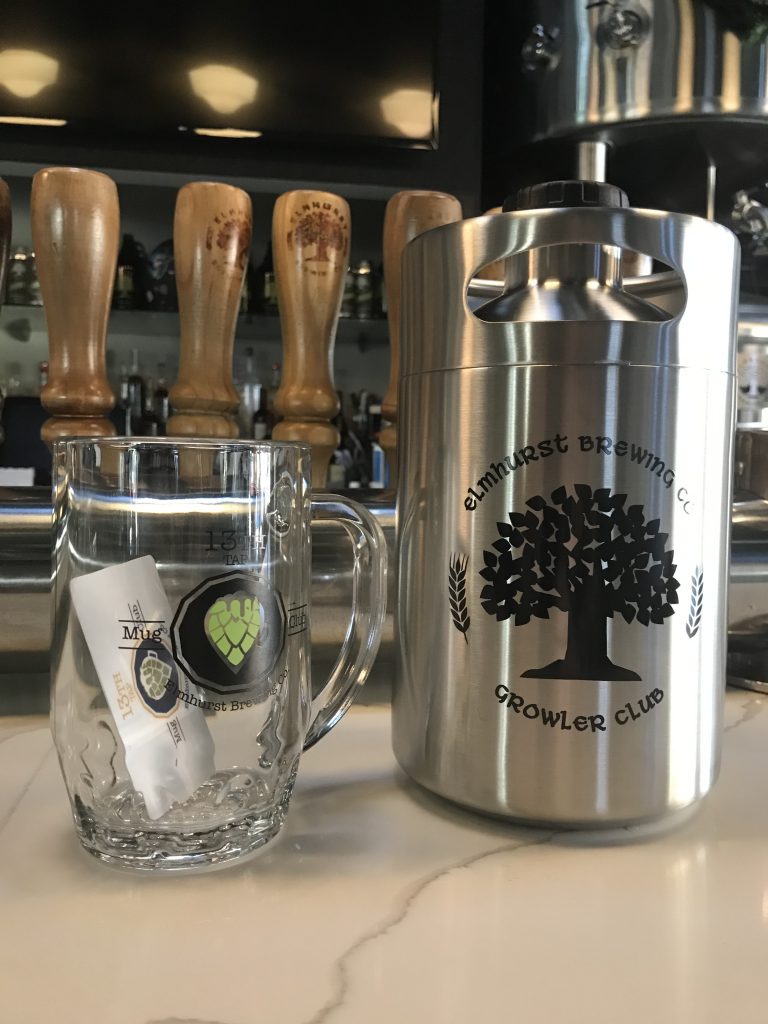
Elmhurst Brewing Co., located at 171 N. Addison in Elmhurst, has the perfect gift ideas for the beer lover in your life, including:
Growler Club membership
Mug Club Membership
Beer-inspired scented candles in a 10oz logo Belgian glass
Holiday logo ornament for your tree
Logo flannels for cold weather
3 new logo hat styles
“Santa’s Liquid Helper:” our Oak Aged Bock style lager, aged 12 months and sold in 750ml bottles with waxed bottles cap tops
Head to their website today to purchase your gift and support local!
2. The Harp & Fiddle
The Harp & Fiddle, located at 110 Main Street in Park Ridge, is a modern Irish pub offering everything from family dinners, dinner for two, take out alcohol and even groceries and essentials for pick-up and delivery!
As a special deal for FFC members, when you order takeout from The Harp & Fiddle in December using the Orange TOAST button on their website and code FFC2020 , you will receive an additional 10% off your order! Treat yourself or your family to a delicious meal from The Harp & Fiddle to help celebrate this holiday season.
3. Pumpkin Moon
Pumpkin Moon, located at 1028 North Blvd in Oak Park, is celebrating its 25th year in business and is your headquarters for fun stocking stuffers and special gifts alike!
From Silly Putty to Lite Brite, Sock Monkeys, 8-balls, Lava Lites, Spirograph and more, they have all the fun stuff to make your holiday extra special. Pumpkin Moon offers curbside delivery and will try to help with any special needs you have.
They do not have a shopping website, so they have made up some ready-to- go kids assortments in different price ranges: $5, $10, $15, $20. Gift Certificates are also available. One size fits all!
4. Scratch ‘n Sniff
Scratch ’n Sniff, located at 120 N. Marion St. in Oak Park, has you covered for gifts for your family, your home and your pet! With new items arriving weekly, Scratch ‘n Sniff carries Pendleton brand items, baskets of toys and winter weather gear for your pets, and fun gift items for the home, including puzzles and their specialty, glass Christmas ornaments in dozens of styles.
Gift Certificates are available as well as curbside pickup.
5. Frame Chicago
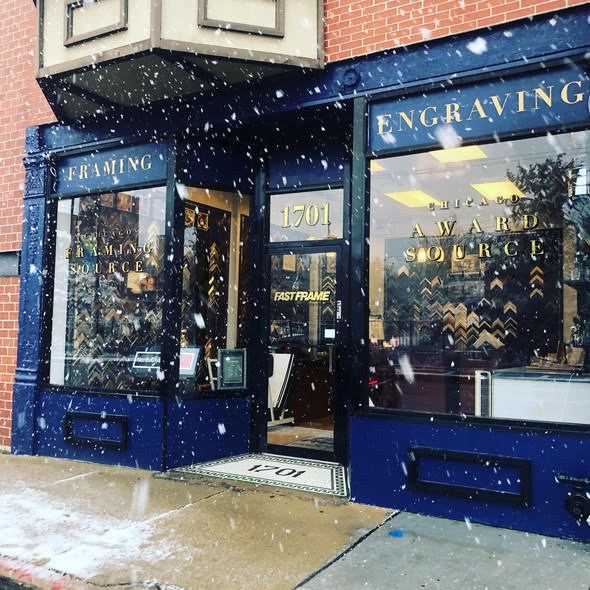
Frame Chicago, located at 1701 N. Clybourn Ave, is a small, female and minority owned custom framing and engraving shop in Lincoln Park.
Create a one-of-a-kind gift with Frame Chicago this season by taking $40 off any custom framing order as a FFC member. This will be valid throughout the holiday season with an expiry date of December 31, 2020.
To see examples of their work, head to @framechicago on Instagram.
6. Jaclyn Beattie Personal Styling
Start 2021 in style by enlisting the services of Jaclyn Beattie Personal Styling. Jaclyn is a professional wardrobe stylist specializing in cleaning out closets (organizing, donating, making a list of what’s missing, etc), personal shopping (from any store, both in person and online) and she designs custom clothing (taking measurements, picking out fabrics, creating garments that are truly your own).
Over quarantine, Jaclyn also started designing and hand-making jewelry using high quality materials- brass, silver, matte gold and 14k gold filled components. She creates her jewelry locally in East Lakeview and can help with any custom jewelry orders as well.
Kie & Kate Couture is a family run, female owned business in Elmhurst located at 559 S. Spring Road. This holiday season, shop their deal of the day, which features their most popular items each day where clients can take advantage of the daily deals to help finish off their holiday shopping!
Use Promo Code LOCALLOVE to receive 20% off Kie & Kate’s Deal of the Day.
8. Wake ‘n Bacon
New Lakeview restaurant Wake ‘n Bacon, located at 420 W. Belmont Ave., boasts a menu of comfort food with Asian and Latin influences. Enjoy a healthy snack like their Halo Halo Chia Chia or Veggie Stir Fry. You can also take advantage of their CBD offerings by adding 25mg to any food or drink on the menu.
This holiday season, when you order online with promo code FFCLV, you’ll receive $5 off your order. Wake ‘n Bacon offers delivery, curbside, or pick-up options, so you can still enjoy brunch any day of the week, because you deserve it.
9. ChooChoo Chicago
ChooChoo Chicago, located at 615 W Oakdale Ave., provides a nurturing, loving, and home-like environment while supporting the academic and social-emotional development of children in our care through an explorative, play-based curriculum.
For those looking for a daycare/preschool program for your toddler in the East Lakeview neighborhood–ChooChoo Chicago currently has an active spot opening. If you are interested, reach out today and schedule your visit prior to December 18th in order to claim 10% off your first-month tuition!
10. A Dog’s Best Friend
A Dog’s Best Friend is a 5 star pet care business in Lakeview that has been in business for over 17 years. A Dog’s Best Friend offers dog walking, pet sitting, cat care and pet events and employs experienced pet handlers, insured and bonded. A Dog’s Best Friend also produces fun interactive pet events helping businesses reach out to their communities. Reach out today via their website for all of your petcare needs!
11. Scout & Cellar
Local Chicagoan Catherine Hall is a wine consultant with Scout & Cellar. Clean crafted wine from grape to glass, try the Scout & Cellar difference. Order your wine online and have it shipped right to your door! Contact Catherine today to book a tasting.
12. Olive Mediterranean Grill
Olive Mediterranean Grill at 1001 W. North Ave has been serving up Chicago’s favorite Mediterranean tastes and flavors that happen to be healthy since 2010.
This holiday season you can buy one plate and get the second one half off with all takeout orders placed between 10:30 AM – 09:00 PM.
13. CarefulPeach
CarefulPeach at 1024 North Blvd in Oak Park offers a unique selection of brands of apothecary luxuries, handmade jewelry, accessories, table linens, fine tabletop pieces, stationery, gourmet foods, cooking accessories, home decor and more.
This December, join CarefulPeach for two free and exciting Virtual Wine Tastings on Facebook! Receive 10% off the purchase of 2 or more featured wines and 15% off a case of wine, mixed cases included. Wine can be purchased online, over the phone or at the shop for curbside or in-store pick up!
14. JAYNE
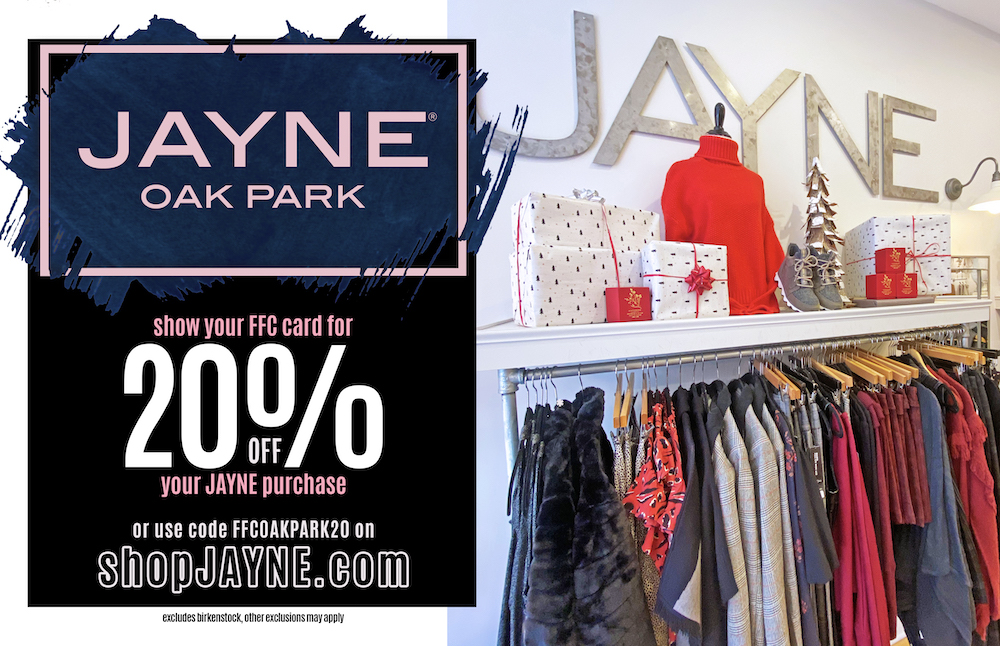
JAYNE Boutique at 122 N. Marion Street in Oak Park aims to to bring an ageless shopping adventure featuring clothing, accessories, and footwear to their 4 brick and mortar locations throughout the Chicagoland suburbs.
During the week of December 7, FFC members will receive 20% off their JAYNE purchase in store or online using promo code FFCOAKPARK20. This promotion will continue for FFC members through December 13 and excludes Birkenstock, other exclusions may apply.
15. Roots Handmade Pizza – Second City and South Loop
Roots Handmade Pizza specializes in high quality, casual comfort food; Quad Cities style pizza, handmade mozzarella sticks, a plentiful salad program and all midwestern beers. The Second City location, 1610 N. Wells, opened in the fall of 2019 and hopes to become a staple in the Old Town neighborhood for many years to come.
Roots Second City and Roots South Loop would like to extend a 15% discount to FFC members through their app or website using the code FFCGC15 for orders over $50.
16. Athleta Shops on Fremont
Athleta Shops on Fremont, 901 W. Weed Street, is releasing their limited edition lace collection the week of December 7. Stop in to shop the collection, support our neighbors who work at Athleta, and enter the in-store raffle for your chance to win a $50 shop card.
Athleta will also have new markdowns in store and will be offering an additional 20% off sale the weekend of December 12.
17. Banana Republic North Ave Collection
Support our neighbors working at Banana Republic – North Ave Collection at 917 W. North Ave the week of December 7. Banana Republic will be having a storewide sale featuring their brand new Winter 2020 collection with special Deals of the Day.
They also offer buy online pick up in-store services and curbside pick-up, with 2 designated pick-up locations in the attached North Ave Collections garage.
18. VIVE Float Studio
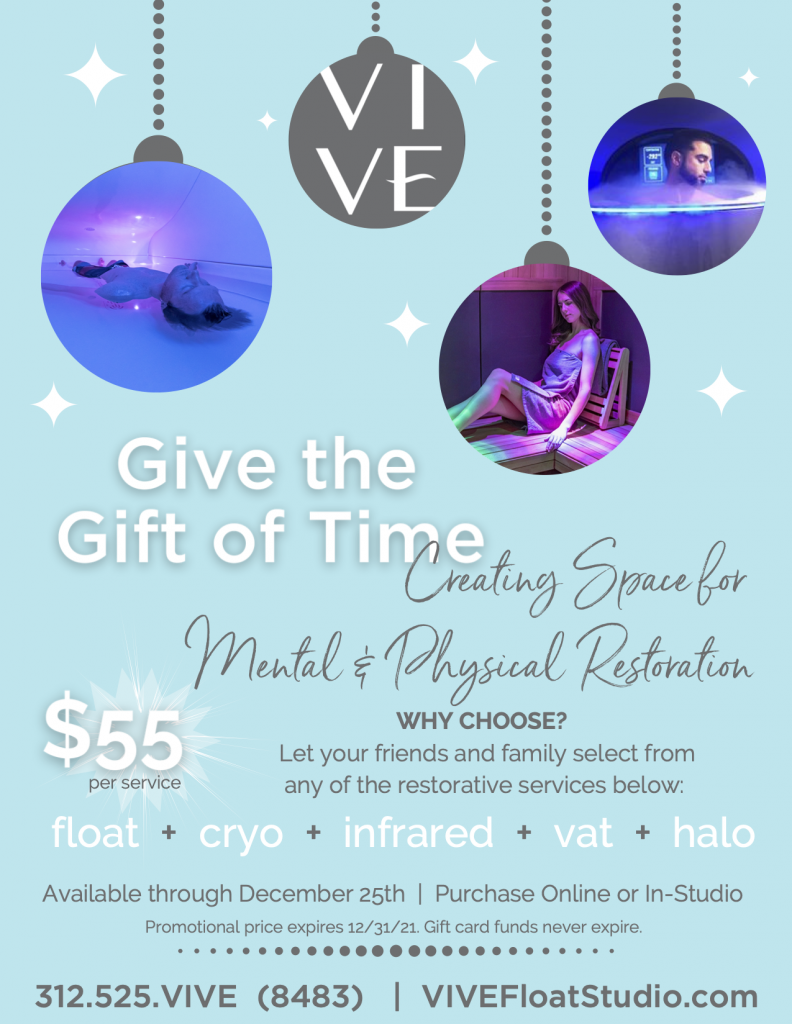
VIVE Float Studio at 1513 N. Wells in Old Town specializes exclusively in Float + Cryo + Infrared + VAT + Halo Therapies. Their boutique total wellness center offers today’s most cutting-edge equipment dedicated solely to providing simultaneous mental and physical rest and recovery.
This holiday season, give the gift of time, creating space for mental & physical restoration for the family and friends that have been there for you through 2020. Any one service is $55. This special is available December 9 – 25. The promotional benefits expire 12/31/21. So stock up on what they (or you) need to stay the best version of yourself all 12 months of 2021! The monetary value never expires.
19. Corey’s NYC Bagel Deli
Corey’s NYC Bagel Deli has two locations in Chicago: 1001 W. North Ave. in Lincoln Park and 515 N. Dearborn St. in River North. Corey’s began serving up NYC bagels to Chicagoans in 2000, and they’re offering a discount for FFC members throughout the month of January!
Please use the code FFC10 at checkout for your special discount on everything on the Corey’s NYC Bagel deli website.
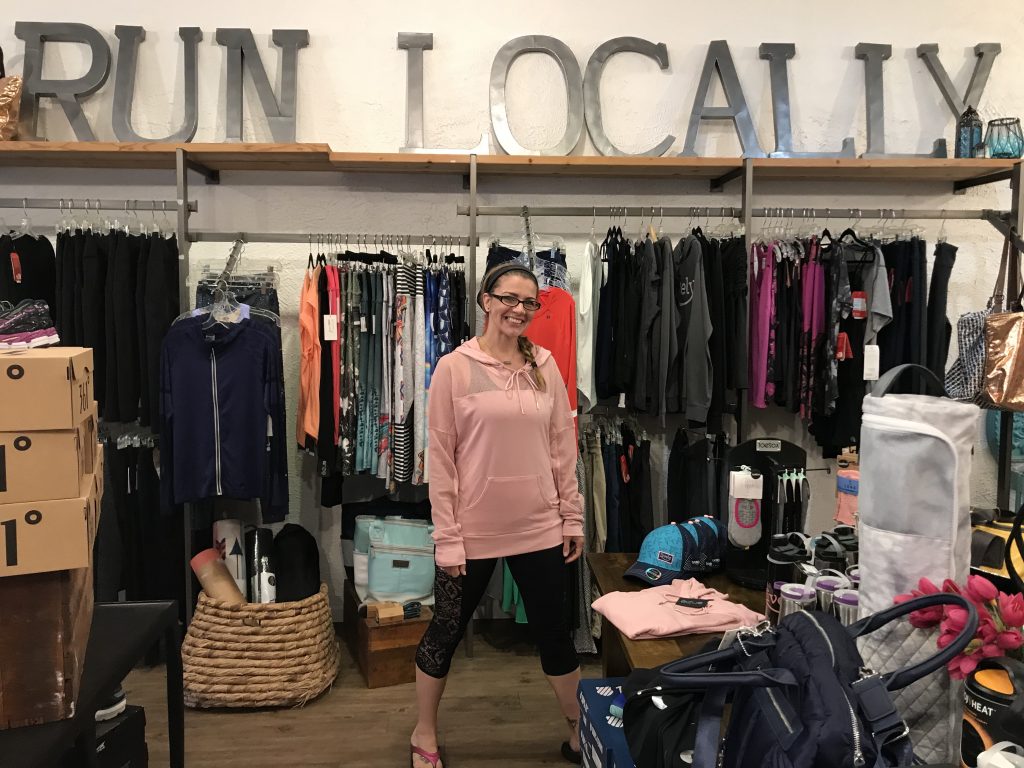
20. Lively Athletics
Lively Athletics at 109 N. Oak Park Avenue is a sister-owned women’s athletic wear shop in Oak Park that’s been serving up athletic apparel and shoes since 2014.
As a special thank you to the FFC community, Lively Athletics is offering FFC members 15% off their online purchases now through 12/31/2020. Use the code “FFC” to apply the discount when shopping online!
21. Cafecito
With four locations throughout Chicago (South Loop, Gold Coast, Old Town and Lincoln Park), Cafecito serves up the flavors of Latin America with their Cuban-inspired menu.
Get 10% off your total purchase when you mention this post to Cafecito staff. Enjoy!
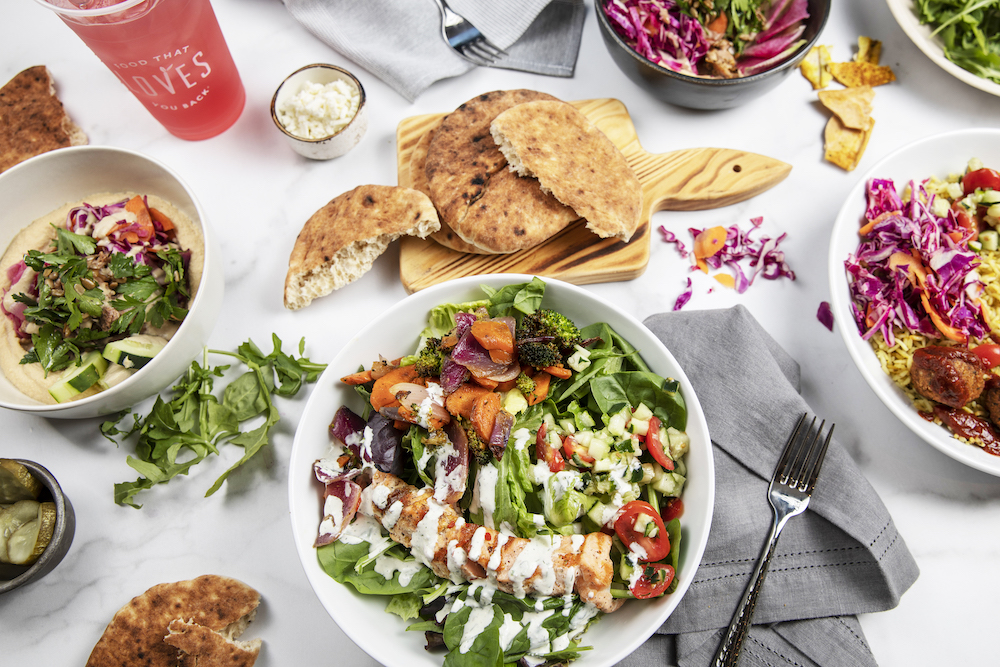
22. Roti
Roti, located at 1000 W North Ave in Lincoln Park, is ready to refuel you with their modern Mediterranean menu.
Support our neighbors who work at Roti by stopping in for pick-up or curbside takeout or ordering delivery from their website.
23. 3rd Coast Cafe
3rd Coast Cafe, located at 1260 N. Dearborn, has been a local favorite in the Gold Coast for 35 years. All winter they will be offering 4 homemade soups daily to keep the chill away, cocktails to go, and amazing deals on mix and match 4/6 packs of wine and beer. Their dinner menu changes nightly and will post by 4 PM daily on their website.
Fun for the Holiday specials include:
Order 2 of our double Lady J Margaritas and receive a complimentary order of Diablo Tacos! (4 tacos, seasoned ground beef, onion, cilantro, cabbage, avocado and lime on flour tortilla with red salsa)
Order any bottle of wine and receive a complimentary 3rd Coast Cheese Pizza!
For FFC members, receive 10% off your online order at 3rdcoastcafe.com for the month of December using promo code FFC2020.
24. JEM Medspa
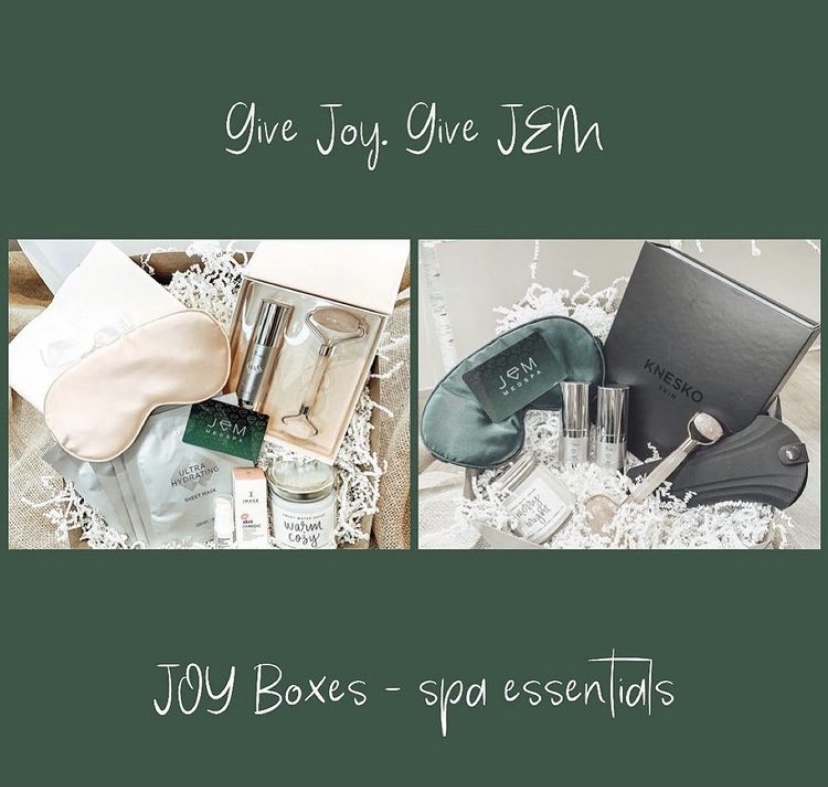
JEM Medspa, located at 210 N York St. in Elmhurst, is the ultimate place for relaxation and comfort. Patients can select from a wide range of services, including facials, injectables, microneedling, nonsurgical skin tightening, or microblading. Designed with a modern and minimalist feel, each detail is thoughtfully planned to help our patients relax.
Give the gift of joy this season with JEM Medspa ‘JOY boxes’ – filled with luxurious spa essentials or treat them with a gift card. It’s the perfect gift for anyone on your list.
25. Good Eats Group
Included in the Good Eats Groups are local restaurants Burger Bar Chicago, Sono Wood Fired, Sociale and Cafe Press Chicago. Good Eats Group is celebrating its 10th year in business and is offering this coffee special as part of its holiday gift lineup.
For just $29.99 you can create the perfect gift by selecting either our exclusive custom blended coffees or our hand dried, hand blended teas. This package includes a jumbo 22 oz. ceramic mug waiting to be coddled by warm hands. Regular and Decaf options available. Shop now on their website.
26. Moody Tongue
Moody Tongue, located at 2515 S. Wabash, is a culinary brewery whosae beers are created with simplicity and balance in mind and can be enjoyed both on their own or paired with food.
Give an interactive gift to those spending more time quarantining at home this holiday season! Renowned brewmaster, Jared Rouben, is offering a limited number of private virtual tasting experiences. Enjoy a variety of beer styles while learning more about the culinary processes, ingredients and techniques which underpin Moody Tongue’s ‘culinary brewing’ philosophy. Please note: they are only able to offer a limited number of tastings; we recommend reaching out ASAP to reserve one of these special experiences.
Private Culinary Beer Virtual Tasting ($145)
Private Barrel Aged Beer Virtual Tasting ($215)
Private Virtual Beer Tasting & Guided Brewery Tour ($475)
Post written by FFC Contributor Natalie Casper.
https://dev.ffc.com/wp-content/uploads/2020/12/Untitled-design.png14002280Sydney MeyerSydney Meyer2020-12-03 10:54:142020-12-03 10:54:14Shop Local: Support These Chicago Businesses This Holiday Season
Here at FFC, we want you to succeed and we’re committed to helping you formulate a plan so you can achieve your personal health and fitness goals. That’s why we created a brand new ebook that is specifically designed to help you make the most of your time while keeping a safe social distance from fellow gym-goers.
When FFC reopened in July 2020, FFC Senior Fitness Director Sarah Ashenden found that she had to adjust the structure of her personal workout program in order to have a more efficient and effective session.
“It’s very time consuming to use a ton of equipment because you need to make sure everything is clean before and after you use it,” she said. “I’ve found that my own workouts have become more simplified, and I’m choosing to use just one set of dumbbells or equipment that is close to each other so I’m not walking all around the gym.”
Using her own experience and the feedback she received from members as they returned to the gym, Ashenden created three workouts that allow you to choose a spot in the club that is a safe social distance from others and use minimal equipment to have a great workout session.
Each of the workouts is paired with a fitness goal to help you choose which is the best fit for you: Get Lean, Improve Endurance and Build Muscle. While each workout can be adjusted based on experience level, Ashenden suggests taking a look at what you’ve been doing throughout quarantine or while at home to choose a starting point for these workouts.
“If you’ve been running or doing cardio outside all summer, maybe start with the Get Lean program to slowly get back into strength training because it uses lighter weights,” she said. “If you’ve been lucky enough to have heavier dumbbells at home, maybe it’s time to switch up the program by working with even heavier weight with the Build Muscle program. And if you’ve been avoiding all exercise, start with the Improve Endurance and the Get Lean programs to ease your way back into exercise.”
If you’re in a place where you feel comfortable with your level of training over the past few months, these workouts can also be used in conjunction with one another as a weekly program. Should you decide to complete these three workouts on a weekly basis, Ashenden notes that it’s important to keep track of the weights you are using and the number of reps you are completing on a weekly basis.
“If by the end of four weeks you’re feeling that the workouts don’t feel as hard anymore, then it’s time to increase your weights, increase your reps or decrease your rest time to progress the program,” Ashenden said.
These workouts are an excellent resource to help you get back into the swing of things and structure your time at the club efficiently. If you have specific goals in mind or are looking for something tailored to your abilities, Ashenden recommends reaching out to the Fitness Director at your club for more information on personal training.
“Hiring a personal trainer is going to take you to the next level beyond what these workouts can do for you,” Ashenden said. “The Fitness Director at each club can best pair you with a personal trainer that will create a program that you really love and that will help you hit any goals that you may not be accomplishing during your workouts.”
Because training is only part of the equation for a healthy lifestyle, Ashenden asked FFC Registered Dietitian Alicia Huggler to include some recipes in our ebook. Even if weight loss is not part of your goal, proper nutrition can give you more energy, decrease pain and inflammation, help with sleep, improve your mood and so much more.
“What we really see at every club is someone who is seeing a registered dietitian to focus on their diet and then getting three to four days of exercise in is going to see results 10 times faster than someone who is just exercising,” Ashenden said.
Ready to take the first step toward a healthier you? Download our ebook today. If you have any questions about the exercises in the ebook or need assistance, please contact Sarah at sashenden@ffc.com or stop by the Fitness Desk at the club to speak with a member of our fitness team who will be happy to assist.
Post written by FFC Contributor Natalie Casper.
https://dev.ffc.com/wp-content/uploads/2020/11/Ebook-image-2280x1400-1.jpg14002280Sydney MeyerSydney Meyer2020-11-12 08:00:362020-11-12 08:00:36Bring It In: 3 Safe Indoor Workouts To Do At The Gym
Be honest: how many of you were lacing up your sneakers and going on regular walks pre-COVID? I don’t mean your power walk to the train or your half walk, half jog to get to the office on time; I’m talking about a dedicated, intentional walk for the purpose of exercise.
I’m an active person who exercises 5-6 times a week, but walking was never really part of my exercise regimen. I like high intensity interval training (HIIT) classes, lifting heavy weights and leaving the gym in desperate need of a shower. Walking never seemed “worth it” to me. Why would I walk for exercise when I could run and burn more calories?
I started walking during quarantine mainly out of embarrassment. Sometimes I would glance down at my Apple Watch and see that I’d only walked 232 steps that day (presumably on my long walks from my couch to my fridge). Once I started going on daily walks, I instantly noticed a shift in my mood, and everyone I talked to during quarantine said the same thing: getting outside, inhaling fresh air and taking a moment to disconnect was doing wonders for their mental health.
I’ve kept up with my daily walk habit, and judging by the crowdedness of my neighborhood’s sidewalks, so has everyone else. As I mentioned, many people have credited walking with helping their mental health during this time, but what does walking provide for us in terms of physical health? Daily movement is obviously important, but with so many options for exercise, why should we choose to walk?
“Walking is beneficial for literally every person because it strengthens the heart,” FFC Group Fitness Instructor Becca Faria said. “Young, old, injuries or no injuries, walking can benefit everyone.”
Faria teaches HIIT classes at FFC, and these quick, efficient workouts have been gaining in popularity over the last several years. HIIT classes may have stolen the limelight from steady state cardio options like walking and biking, but that doesn’t mean it shouldn’t be included in your training plan.
“If you’re a high intensity interval training type of person who is always putting that strain on your body, it’s good to supplement your program with steady state cardio like walking because it is lower impact and helps you recover more quickly,” Faria said.
In fact, if weight loss is one of your goals, Faria said “walking absolutely needs to be part of your routine” because steady state cardio helps train your body to be more efficient at using fat to fuel muscle activity.
“If you’re in a high intensity interval training (anaerobic) zone, you’ll be pulling energy from carbohydrates, but if you’re in a steady state cardio (aerobic) zone, then you’re going to be pulling from your fat stores,” Faria said. “This makes a huge difference, and it’s definitely beneficial if you’re trying to lose weight.”
Fitness trackers like Fitbit popularized the goal of hitting 10,000 steps per day, but Faria said the amount of time you should spend walking per day can depend on your goals.
“The very minimum amount of walking to try to hit would be 30 minutes a day, 3 to 4 times a week,” Faria recommends. “If you’re in this to lose weight, I would definitely increase that to 1 hour for 4 to 5 days a week.”
If you’re transitioning your daily walk indoors to a treadmill as the weather turns colder, Faria suggests playing with incline intervals to add some variety to your cardio session. For example, you could begin by walking 1 minute at incline 1, 1 minute at incline 2, going all the way to incline 5 and then returning to incline 0.
“In terms of your speed, make sure you do a 2-3 minute warm-up and then get into that 5 or 6 zone on the rate of perceived exertion (RPE) scale (50-70% of your maximum heart rate), and try to stay within that fat burning zone for as long as you can,” Faria said.
Keep in mind that walking is only one example of steady state cardio, and you can choose how to get in your 30 minutes per day.
“If you’re the type of person who would get bored walking for 30 minutes, I suggest switching up machines for your steady state cardio,” Faria said. “You could use a stationary bike, an elliptical, a treadmill and do 10 minutes of steady state cardio on each machine, hitting that RPE of 5-6 for your 30 minutes.”
Steady state cardio can serve as your entire workout for the day, or you can tack it onto the end of your lifting session or HIIT class.
So, the next time you’re in the middle of a Netflix marathon and think to yourself “maybe I should go for a walk,” know that both your body and your mind will thank you and that it’s definitely worth your while.
Post written by FFC Contributor Natalie Casper.
https://dev.ffc.com/wp-content/uploads/2020/10/can-walking-help-you-lose-weight-blog-post.png14002280Sydney MeyerSydney Meyer2020-10-22 08:00:342020-10-22 08:00:34Can Walking Really Help You Lose Weight?
Grab your candy, popcorn and blankets, folks, because it’s officially spooky movie season!
If your family or friend group is anything like mine, you might find yourself watching a certain Halloween movie more than once this October (cough: Hocus Pocus). Keep things interesting this year by challenging yourself or your friends to follow along with one of these spooky workouts during your next movie night.
Tune in to these family-friendly flicks and get ready to work up a sweat!
Hocus Pocus (1993)
This cult classic Halloween flick follows the story of the Sanderson Sisters, a trio of witches, who are resurrected by a Salem teen on Halloween night. Currently streaming on Disney+.
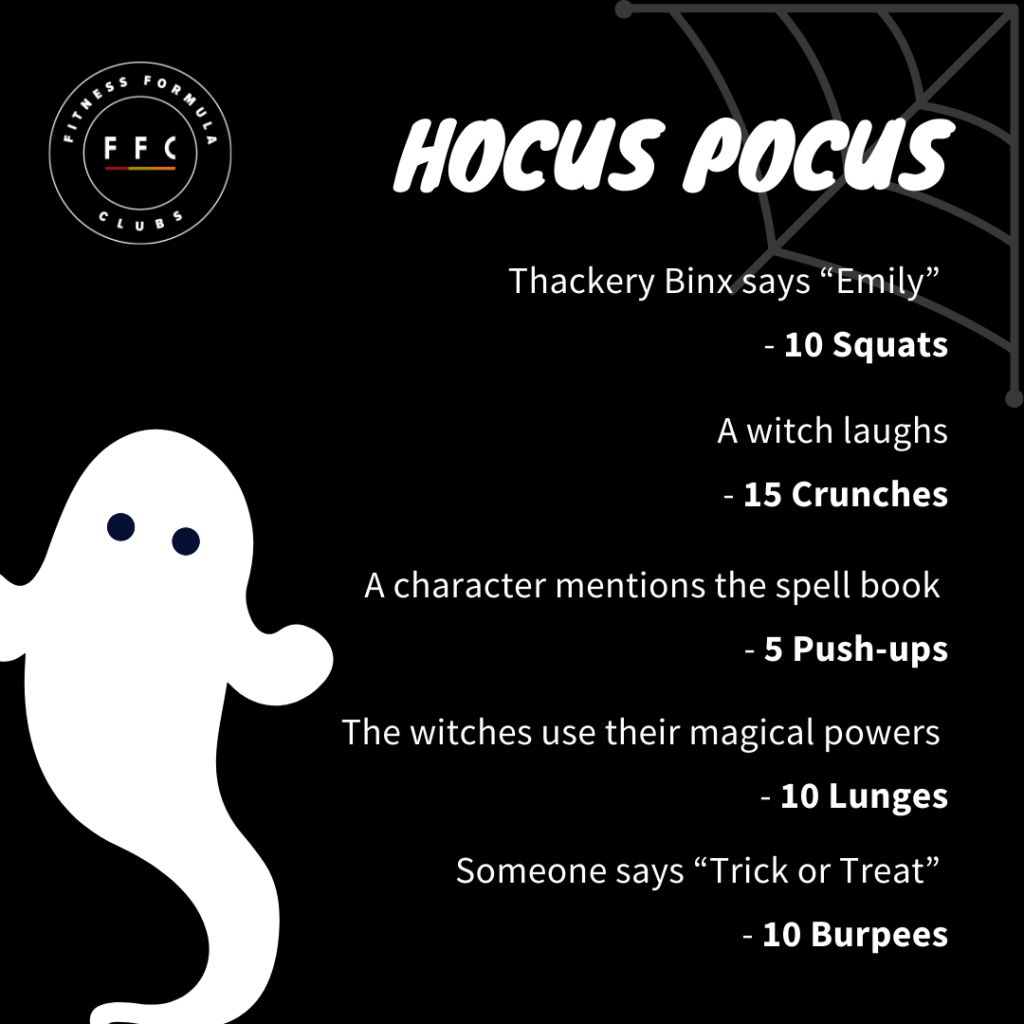
Thackery Binx says “Emily”: 10 Squats
A witch laughs: 15 Crunches
A character mentions the spell book: 5 Push-ups
The witches use their magical powers: 10 Lunges
Someone says “Trick or Treat”: 10 Burpees
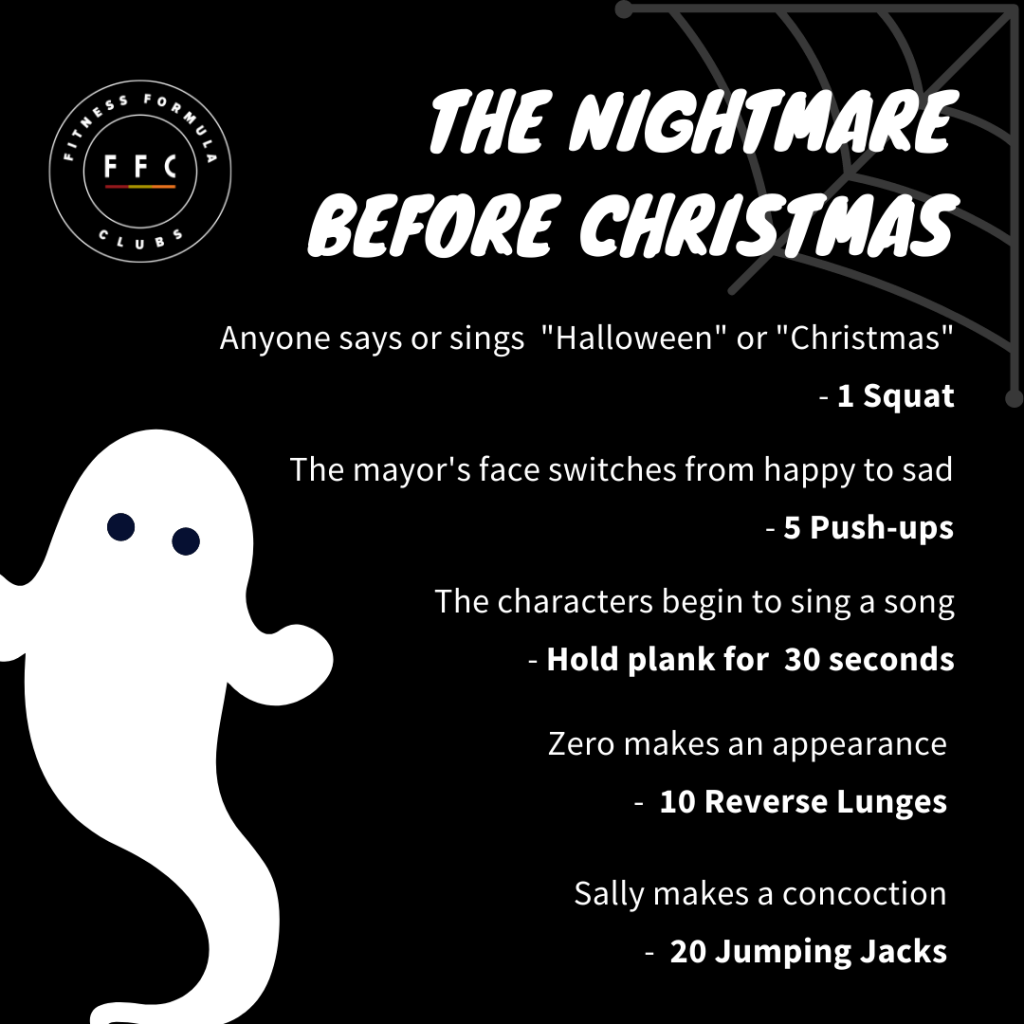
The Nightmare Before Christmas (1993)
Halloweentown’s Pumpkin King, Jack Skellington, trades the spooky and scary haunts of Halloween for the warm traditions of Christmas in Tim Burton’s 1993 stop-motion animated film. Currently streaming on Disney+.
Anyone says or sings the words “Halloween” or “Christmas”: 1 Squat
The mayor’s face switches from happy to sad: 5 Push-ups
The characters begin to sing a song: Hold plank for 30 seconds
Zero makes an appearance: 10 Reverse Lunges
Sally makes a concoction: 20 Jumping Jacks
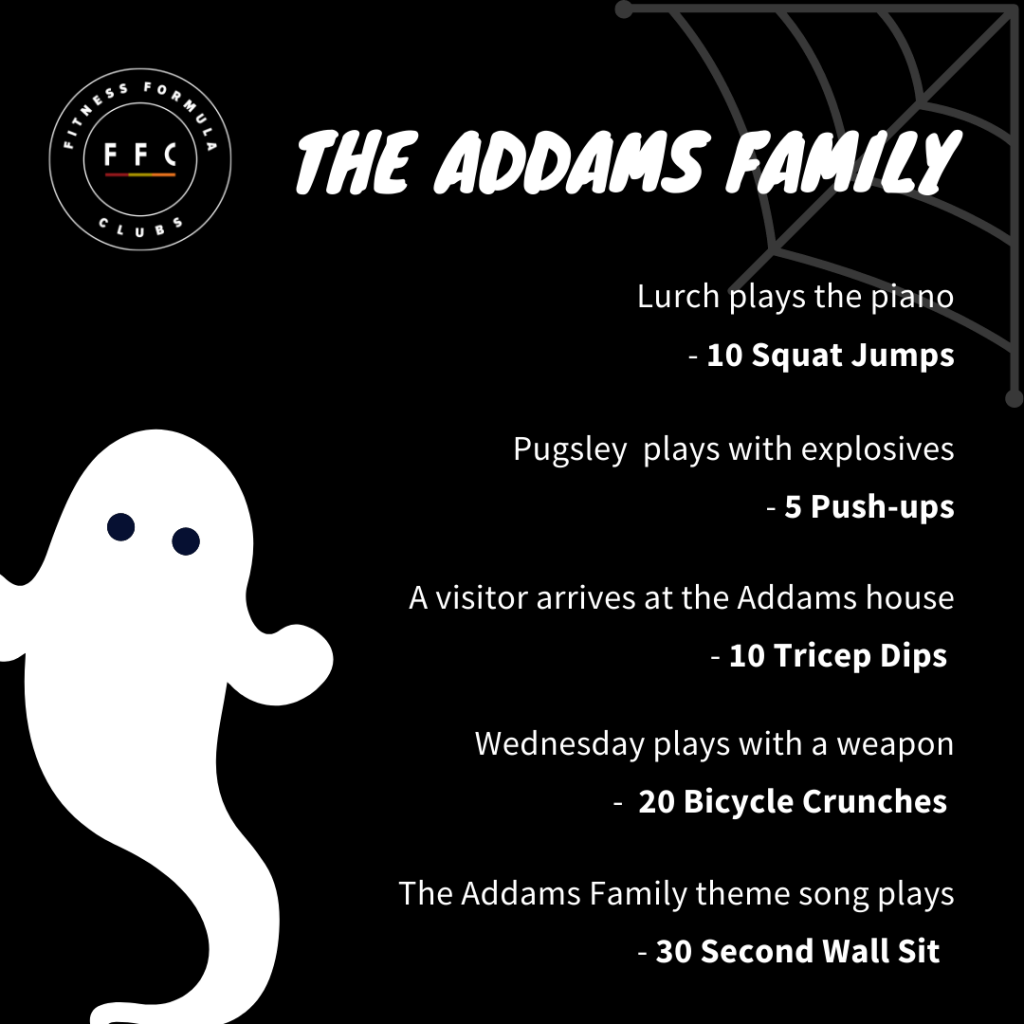
The Addams Family (2019)
The latest iteration of The Addams Family franchise stars the voices of Oscar Isaac, Charlize Theron, Chloë Grace Moretz, Finn Wolfhard, Nick Kroll, Snoop Dogg, Bette Midler, and Allison Janney.The animated film is currently streaming on Hulu.
Lurch plays the piano: 10 Jump Squats
Pugsley plays with explosives: 5 Push-ups
A visitor arrives at the Addams house: 10 Tricep Dips
Wednesday plays with a weapon: 20 Bicycle Crunches
The Addams Family theme song plays: 30 Second Wall Sit
Post written by FFC Contributor Natalie Casper.
https://dev.ffc.com/wp-content/uploads/2020/10/spooky-movie.png14002280Sydney MeyerSydney Meyer2020-10-15 08:00:312020-10-15 08:00:31Make Your Halloween Movie Night Extra Spooky With These Workouts
The health and wellness space is no stranger to diet trends. Joining the ranks of celery juice and ketogenic diets in popularity this year is intermittent fasting (IF). And while intermittent fasting has been making headlines, does this trending topic really deliver on its supposed health benefits?
Intermittent fasting has been gaining popularity since 2012 when BBC broadcast journalist Dr. Michael Mosley released his TV documentary Eat Fast, Live Longer and book The Fast Diet. Journalist Kate Harrison’s book The 5:2 Diet based on her own experience, and Dr. Jason Fung’s bestseller The Obesity Code also generated much buzz on the effectiveness of intermittent fasting.
What Is Intermittent Fasting?
So what exactly is IF, and why all the hype? Also known as intermittent energy restriction, intermittent fasting is derived from traditional fasting, a universal ritual used for health or spiritual benefit as described in early texts by Socrates, Plato, and religious groups. IF is an umbrella term for various meal timing schedules that cycle between voluntary fasting and non-fasting over a given period. Promoters of IF claim that it can improve markers of health that are associated with disease and change body composition.
This voluntary fasting and non-fasting can be split up in a number of ways, including these popular methods:
Alternate Day Fasting
In Alternate Day Fasting, you alternating between days of no food restriction and days that consist of one meal that provides about 25% of daily calorie needs. For example: Mondays, Wednesdays and Fridays would consist of fasting, while the alternate days would carry no food restrictions.
5:2 Fasting
The 5:2 diet approach advocates no food restriction five days of the week, cycled with a 400-500 calorie diet the other two days of the week.
Time-Restricted Fasting
In Time-Restricted Fasting, there is a designated time frame each day for fasting. For example, meals are eaten from 12 – 8 PM, with fasting during the remaining hours of the day. The most popular time-restricted fasting is 16:8 (fast for 16 hours of the day, eat for 8 hours of the day).
Potential Health Benefits of Intermittent Fasting
There is some emerging research on IF that looks promising in terms of potential health benefits such as fat loss, blood sugar control, and cognitive effects. However, there is still a lot of research that needs to be done on the long term effects in humans.
Specifically for women, it is important to understand that the majority of studies done on IF is on animals and men. Females may react differently to fasting than men due to differences in hormones, so it is important to watch for changes in menstrual cycles or any other negative symptoms.
Individuals with the following conditions should abstain from intermittent fasting:
Diabetes (advanced or on medication)
Eating disorders
Use of medications that require food intake
Active growth stage, such as in adolescents
Pregnancy, breastfeeding
Potential Pitfalls of Intermittent Fasting
Interference with culture, work, and social settings.
Eating is so much more than just fueling our bodies and is a very social activity. Many celebrations, milestones, and special occasions revolve around food. With IF, it may be difficult to participate in social gatherings and other events.
Possible increased fixation on food.
Prolonged periods of food deprivation increases the risk for overeating when food is reintroduced, and may advance other unhealthy behaviors such as an increased fixation on food.
Possible negative side effects.
Side effects may include increased hunger, irritability, reduced ability to concentrate.
Nutrient needs may not be met.
When you restrict food, you restrict nutrients. If you are intermittent fasting, it is important to focus not only on timing of eating, but the foods you are eating to make sure you are getting a variety of nutrients.
The Bottom Line
When someone comes to me and asks about IF, the first thing I want to get down to is the WHY behind the reasoning for intermittent fasting. What are you seeking to accomplish? Is it weight loss? Blood sugar control? Increased energy?
Intermittent fasting is not a magic pill, but it may help certain individuals with their health goals and eating patterns. If you don’t have any issues with hunger, headaches, lightheadedness, low blood sugar, or preoccupation with always thinking about food, then it may be beneficial if it is realistic for your lifestyle.
If you do experience these symptoms, or if it isn’t realistic for your lifestyle, know there are many other ways to accomplish your health goals that do not require following a “diet”. Work with a Registered Dietitian to determine a personalized plan for your specific medical history, health goals, and lifestyle.
Interested in learning more or speaking with one of our FFC Registered Dietitians? Email nutrition@ffc.com today to schedule a 15 minute discovery call!
Post written by FFC Registered Dietitian Chelsea Rice.
https://dev.ffc.com/wp-content/uploads/2020/10/IF-blog-post.png14002280Sydney MeyerSydney Meyer2020-10-08 08:00:382020-10-08 08:00:38The Truth About Intermittent Fasting
Here in Chicago, we joke that the city only has two seasons: winter and construction. And with winters as notoriously brutal as ours, it’s no wonder that Chicagoans wait all year for the fleeting 100 days of summer. The city comes alive in the summertime with movies in the parks, festivals in the streets and crowds spilling out of Wrigley Field.
This summer, however, in the midst of the coronavirus pandemic, bicycles replaced Lollapalooza tickets as the must-have item of the season, and runners and walkers took to the lakefront with renewed enthusiasm for logging their daily steps.
With the temperatures starting to drop, we want to encourage Chicagoans to stay active by moving their outdoor workouts indoors to FFC.
FFC Group Fitness Director Lois Miller and FFC Group Fitness Manager Lara Mele, both outdoor fitness enthusiasts in their own right, have developed two 30 minute workouts and accompanying playlists to assist with the transition to indoor cardio sessions.
Lace up those running shoes or clip into a stationary bike, and let’s get moving!
Rate Of Perceived Exertion (RPE)
For these 30 minute workouts, Lois and Lara both measure different levels of intensity using a Rating of Perceived Exertion (RPE). Do you best to push yourself or take it easy based on Lois and Lara’s recommendations for RPE throughout the workouts.
30 Minute Treadmill Workout
Lois’s RPE Scale: Intensity levels are based on a scale of 1 – 10 (how hard do you think you are working?) 1 = complete rest, 6 = conversational moderate intensity, 8 = fast/hard to maintain conversation, 10 = maximum effort
A great playlist makes for a great workout. Tune in to Lois’s Spotify playlist for this workout below!
Warm Up Jog/Run (5 minutes)
Before jumping into the warm up, please take a few minutes to walk or incorporate some dynamic stretches to get your blood flowing and muscles warm.
Jog: Incline 1.0 / Speed RPE: 6 (1 minute)
Run: Incline 1.0 / Speed RPE: 8 (1 minute)
Jog: Incline 1.0 / Speed RPE: 6 (1 minute)
Run: Incline 1.0 / Speed RPE: 8 (1 minute)
Walk Rest: Incline 1.0 / Speed RPE 3 (1 minute)
Drill 1: Rolling Hills (6 min 15 sec)
For our first drill, set and keep your speed at an RPE of 6 (scale of 1 – 10, a 6 is moderate intensity). While your speed stays the same throughout, your incline will change every 45 seconds.
Incline 1.0 – 45 seconds
Incline 4.0 – 45 seconds
Incline 2.0 – 45 seconds
Incline 6.0 – 45 seconds
Incline 3.0 – 45 seconds
Incline 8.0 – 45 seconds
Incline 4.0 – 45 seconds
Incline 1.0 – Recovery Walk for 45 seconds
Drill 2: Speed Work (7 minutes)
For our second drill, the goal is to keep your speed at an RPE of 8 (scale of 1 – 10, an 8 is fast/hard to maintain conversation) while the incline changes. You will have 6 sprint intervals, 30 seconds on, 30 seconds off.
Incline 1.0: 30 seconds on, 30 second recovery (straddle the treadmill)
Incline 3.0: 30 seconds on, 30 second recovery (straddle the treadmill)
Incline 1.0: 30 seconds on, 30 second recovery (straddle the treadmill)
Incline 3.0: 30 seconds on, 30 second recovery (straddle the treadmill)
Incline 1.0: 30 seconds on, 30 second recovery (straddle the treadmill)
Incline 3.0: 30 seconds on, 30 second recovery (straddle the treadmill)
For our third and final drill, begin walking at a comfortable pace, no faster than 4.0. Input treadmill to Incline 15 and continue to walk as the treadmill reaches an Incline of 15.
Once you hit the incline, continue walking for 1 more minute. Return the treadmill to Incline 1.0, and continue to walk as the treadmill declines.
Once it reaches 1.0, stay there for another minute. Repeat this process for a total of 4 rounds.
Congratulations, your workout is complete! Be sure to stretch your hamstrings, quads, glutes, calves and upper back after your workout.
30 Minute Cycling Workout
Lara’s RPE Scale: Intensity levels are based on a scale of 1 – 4 (how hard do you think you are working?) 1 = easy, light 2 = moderate, aerobic endurance 3 = hard, challenging effort, 4 = breathless, all out
RPMs: Stands for rotations per minute. This is your cadence, or speed of the your legs, on the bike.
Lara’s class is built off of the Spotify playlist below. Tune in and get ready to sprint and climb to these Top 40, Dance, Rock and Alternative tunes all released in 2020!
Song 1: Lose Control (Pink Panda Remix) – MEDUZA, Becky Hill, Goodboys, Pink Panda (2:51)
Start your ride with an easy spin (80-90 rpms) and light resistance. You have two chances to raise your intensity a touch and spin up over 100 rpms at :45-1:15 & again at 2:15-2:45. RPE 1-2.
Song 2:Malibu – Kim Petras (3:11)
Start climbing your first of 3 hills during this song by adding resistance and slowing that cadence to 65 rpms. Pop out of the saddle during the chorus. RPE 2-3.
Song 3: Head & Heart (feat. MNEK) – Joel Corry, MNEK (2:45)
Get ready for some 2-count jumps during this song. Be sure you give yourself enough resistance when you stand up. 3 sets of 16 jumps on :38-1:09, 1;25-1:56 & 2:12-2:45. RPE 3.
Song 4: Don’t Start now – Dua Lipa (3:03)
Climb #2 at 65 rpms, maintain that steady cadence. Increase your resistance slightly and stand up for 30 seconds at :33, 1:27 & 2:30 on the clock! RPE 3.
Song 5: Hero – Weezer (3:56)
Ride easy while you recover from your hill, and get ready for BREATHLESS sprints. You have 3 sprints, and you can choose to do these seated at 100-120 rpms or standing 85-105 rpms. Hit it hard at :54-1:22, 2:03-2:30 & 3:25-3:45 on the clock. Earn those recoveries by going as hard as you can on your sprint! RPE 4.
Song 6:Smile – Katy Perry (2:46)
Ride easy to recover from your last sprint then slowly bring yourself back into RPE 2 at 100 rpms. Try to keep it steady as you spin those legs fast, but keep your heart rate from rising too high.
Song 7: I Really Wish I Hated You – blink-182 (3:10)
Settle in at 70-75 rpms for your final climb. This climb is not as steep as your previous climb, but you have 3 hard accelerations on this hill. Add resistance and pick up your rpms by 15-20 at :55-1:09, 1:35-2:05 & 2:43-3:10. RPE 3-4.
Song 8: Blinding Lights – The Weekend (3:20)
Spin easy for about 60 seconds while you recover from your last climb. Then get ready to ramp it up again with a goal or 100-110 rpms at 1:00-1:34, 1:57-2:19 & 2:42-3:05. Remember to add enough resistance so you don’t bounce in the saddle. RPE 2-3.
Song 9: Father of All – Green Day (2:31)
Finish your ride with some short, HARD sprint efforts. Increase your resistance and jump out of the saddle and SPRINT at :45 (10 seconds), 1:37 (10 seconds) & 2:00 (30 seconds). RPE 4.
Song 10:Level of Concern – Twenty One Pilots (3:40)
You made it! Time to cool-down. Ride easy to finish your workout to this latest release by Twenty One Pilots. RPE 2-1.
Post written by FFC Contributor Natalie Casper, with workouts created by FFC Group Fitness Director Lois Miller and FFC Group Fitness Manager Lara Mele.
https://dev.ffc.com/wp-content/uploads/2020/09/bring-your-workout-indoors.png14002280Sydney MeyerSydney Meyer2020-09-30 18:07:512020-09-30 18:07:51Goodbye, Chicago Summer: Move Your Exercise Routine Into The Club With These Two Cardio Workouts
You can’t pour from an empty cup. Secure your own oxygen mask before helping others. Love yourself first. We all know that it’s important to take care of ourselves, but how often are we actually following through with feel-good rituals? “Self-care” has become a bit of a buzzword these days, but what does it mean, exactly?
Acts of self-care include all the things you do to take care of your well-being in four key dimensions – your emotional, physical, psychological and spiritual health. Because it’s much easier said than done to “just relax,” here are some easy ways to take care of yourself on a daily or weekly basis.
1. Shower aromatherapy
Turn your nightly shower into an impromptu aromatherapy session by using moisturizing, scented shower gel.
2. Take an epsom salt bath
Epsom salts help remove toxins from your body and promote deep relaxation.
3. Use lotion daily
Use oil or lotion on your skin, all over your body. Do this daily. The best time is right after you get out of the shower.
4. Try dry brushing
Use a natural bristle brush in a circular motion. Start from the extremities (feet and hands) and move toward the heart. This helps your lymphatic system remove impurities, and done regularly, may help to reduce the appearance of cellulite.
5. Stay hydrated
Don’t forget your H2O: it’s one of the best things you can do for your health.
6. Get creative
Pick up a new hobby or reconnect with your love of drawing, painting, singing or playing music.
7. Create your own mantra
Choose words that have meaning for you, that express the way you want to live and be.
8. Catch some z’s.
Take an afternoon nap or enjoy a morning without an early alarm.
9. Start and end your day with intention
Make morning and nighttime routines that will set you up for a positive day and for restful sleep.
10. Move your body
Be sure to get up and move around at least once an hour.
11. Go outside
Grab some fresh air and Vitamin D.
12. Write it down
Try journaling. An easy way to start is to make a list of things you are grateful for in the moment or 10 things you love about yourself.
13. Set screen time limits
Establish some boundaries around your screen time, particularly before bed.
14. Book a massage
The Spa at FFC is open and our experienced massage therapists are ready to help you relax and recover with a massage. See our offerings here.
15. Try these self-massage techniques at home
Evening Foot Massage
Take off your shoes and socks. Apply massage lotion to one foot at a time.
Cross your ankle over the other knee and place a towel under your foot.
Take hold of both sides of your foot and gently rock it from side to side.
Apply lotion and rub the length of your foot
Rub with circular motion around each ankle bone
Hold the joint where each toe connects with your foot, Hold each toe one at a time and rotate the toes
Gently apply compression starting by squeezing around the toe joints. Release and move 1/2 “ towards the ankle, squeeze again. Repeat for the whole foot.
Thread your fingers between the toes to spread them apart, flex and bend the toes
Place your thumb in the arch of your foot, rest fingers on top and press up and in with the thumb. Move ½” towards the ankle and repeat.
Leg Refreshing Massage
Extend your leg, with both hands press the fingers lightly into the leg on each side of the ankle bone. Gently pull up the leg in short strokes towards the heart. Continue past the knee like you’re pulling up your stockings. This is very refreshing, stimulates circulation and helps lymphatic drainage.
Post written by FFC Contributor and Massage Therapist Sam Wolf.
https://dev.ffc.com/wp-content/uploads/2020/08/self-care.png14002280Sydney MeyerSydney Meyer2020-09-01 09:00:102020-09-01 09:00:10Self Care At Home: 15 Ways To Decompress Right Now
Whether you run for 15 minutes to relieve stress or you’re training for your 100th marathon, you are considered a runner in my books. Unfortunately, runners are quite injury prone because of the redundant nature of the activity, the lack of stretching and the absence of cross training.
If you have ever been to a yoga class, you can easily spot the runners in the class because they tend to be the least flexible participants in the room. Additionally, when you are at the gym, it’s easy to spot the “cardio junkies” because they jump off the treadmill without following up their workout with any particular stretching or cross training.
After injuring myself while training for my first marathon, I quickly learned the importance of stretching and cross training to prevent injury. No matter where you are in your running journey, these stretches and exercises will benefit your overall fitness routine and can help ward off running-related injuries.
Favorite Stretches for Runners
My general rule of thumb for stretching: if you used that muscle during your workout, then you should stretch that muscle after your workout. Stretching is an important piece of injury prevention, and it really only takes a couple of minutes out of your day. The stretches below are some of my favorites that I like to incorporate with my patients who are runners.
Hip Flexor and Quad Stretch
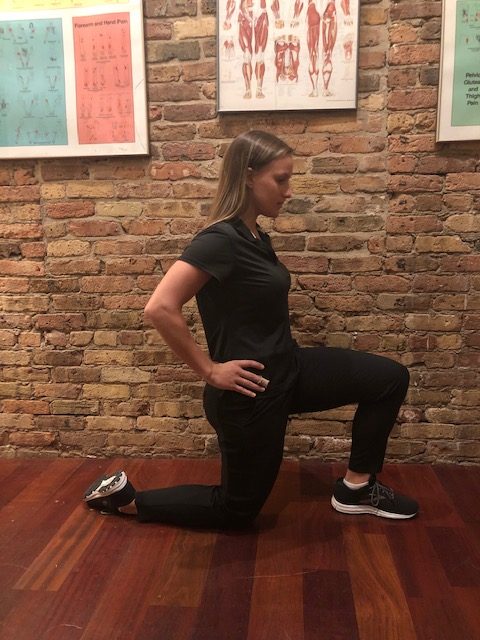
In the half kneeling position, with your knee on a mat/cushion, tuck your tailbone and push your hips forward. You should feel a stretch in the front of your hip on the side that is in the kneeling position.
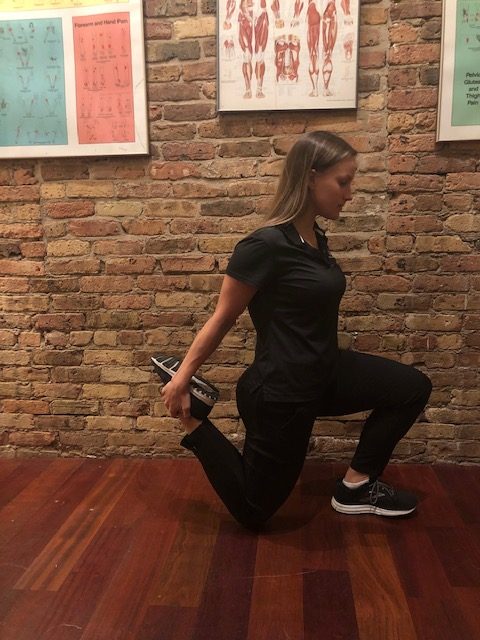
For an added quad stretch, reach behind you and grab your ankle to bring it close to your glutes. Perform 3 sets of 30 second holds on each side.
Hamstring Stretch
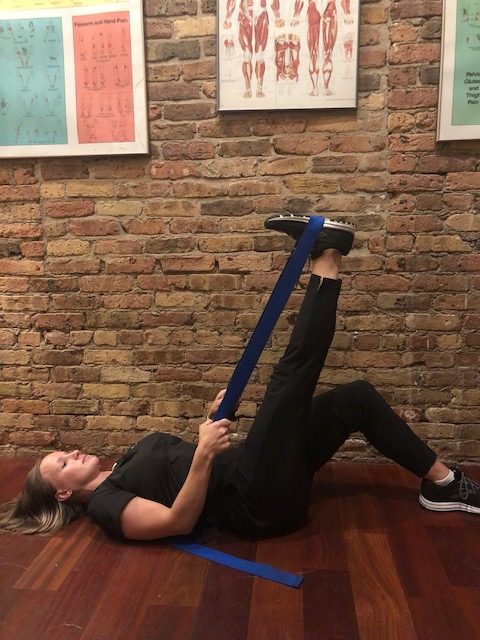
Lying on your back with your knees straight and legs resting on the floor, loop a belt or strap around the bottom of your foot. Use the belt or strap to perform a comfortable stretch behind the back of your leg and knee. Perform 3 sets of 30 second holds on each leg.
Figure Four Stretch
Lying on your back with your knees bent and feet flat on the floor, cross the leg you intend to stretch across your other leg keeping your ankle at your knee. Place both hands behind the thigh of your uncrossed leg and gently pull your knee towards your chest, feeling a stretch in the buttocks of your crossed leg. Perform 3 sets of 30 second holds on each leg.
Calf Stretch
Find a step or a wall to put your toes on, straighten out your knee, then push your heel down into the floor and lean into the wall. Do this with your knee straight and then a slight bend in the knee. Perform on each side for 3 sets of 30 second holds.
Favorite Exercises for Runners
Runners typically have poor single leg stability and lack strength in their glutes. Coincidentally, these weaknesses are directly related to one another. The exercises listed below will target many different muscles in the posterior chain that will ultimately build strength in the muscles that are often weak in runners.
Lateral Lunges
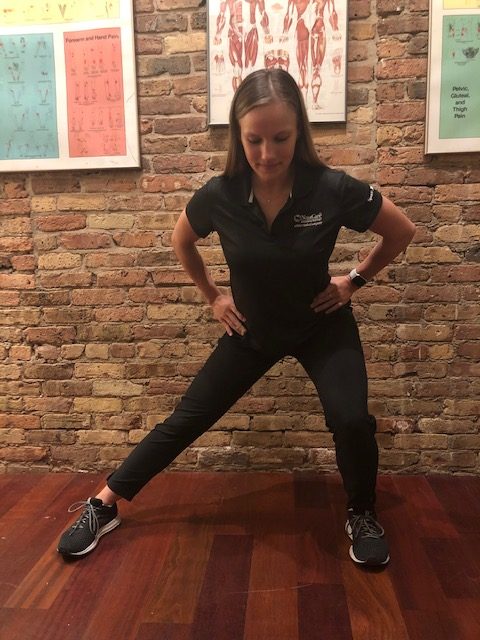
Start by standing with feet at shoulders width apart. Take a small step sideways toward the side to be exercised, shifting your weight onto that foot and allow the knee to bend. Perform 3 sets of 15 repetitions.
Single Leg Bridges
Begin by lying with knees bent and both feet flat on the floor with arms at your sides. Lift one foot off the floor towards the ceiling and straighten the knee. With one leg, squeeze your glutes and raise your hips off the surface trying to keep your hips level. Perform 3 sets of 15 repetitions.
Side Lying Hip Abduction
Lie on your side with the side you intend to exercise upwards. Keep your knee straight and lift your top leg up towards the ceiling. Avoid pointing your toes towards the ceiling by keeping the outside of your foot parallel with the floor, and make sure to stay lying directly on your side and avoid rolling backwards. Slowly lower your leg back to the starting position. Perform 3 sets of 15 repetitions.
Fire Hydrants
Starting Position: Begin in quadruped position with hands directly under shoulders and knees directly under hips. Engage your core by bringing the belly button towards the spine. While maintaining a tight core, activate your glutes and slowly lift one leg out to the side, keeping the knee bent. Only go as high as you can without letting the back arch. Slowly return leg to starting position. Repeat on opposite side. Tip: Do not let your back arch by keeping your core and glutes engaged throughout. Perform 3 sets of 15 repetitions on each side.
If you are feeling pain while running, that is non-emergent, NovaCare offers free injury screens that can easily be set up so that you can understand your injury and get a recommendation about where to go and what to do. There are so many injuries that can occur with runners so it is impossible to address them all in one article.
Additionally, Video Gait Analyses (VGA) are available at select NovaCare facilities. Video Gait Analyses utilize force plate technology combined with videography to identify discrete biomechanical faults that could be impacting your running form. VGAs can be done with or without a script to help meet your running needs. To find out more information, call your local NovaCare Rehabilitation.
Post written by FFC Contributor and NovaCare Lincoln Park Physical Therapist Claire Remec.
Claire Remecis a physical therapist at NovaCare Rehabilitation’s Lincoln Park center. She brings a soothing level of energy and outgoing personality to the patients she treats. Claire enjoys running and treating patients of all kinds, is experienced in Women’s Health therapy, and has a passion for promoting wellness for all.
https://dev.ffc.com/wp-content/uploads/2020/08/man-running-on-treadmill.png14002280Sydney MeyerSydney Meyer2020-08-25 12:23:002020-08-25 12:23:00Runners, Take Note: These 8 Exercises Could Help Prevent An Injury
Welcome to our “new normal.” Nowadays if you want to return to your favorite gym/health club for a workout, wearing a mask is most likely an essential accessory. “That sounds awful!” you say? Well, I am here to tell you it’s actually not that bad.
First, for anyone in good health with no underlying health concerns that might make wearing a mask exceptionally difficult, wearing a standard cloth or disposable mask (we are not talking about hospital grade PPE) while exercising is not harmful. The American Lung Association, CDC and the World Health Organization (just to name a few) have stated that the use of surgical face masks does not result in dangerous oxygen level depletion. Recently, Dr. Maitiu O. Tuathail, a doctor based in Dublin, conducted his own test in response to the repeated queries he received on his Twitter account as to whether masks affect oxygen levels. His results? They did not show a lowering of oxygen levels.
So, now that we have gotten that out of the way, let’s get to what you really want to hear: “Are you sure it’s not that bad to workout in a mask?” Yes, I believe so. In fact, I feel I have become somewhat of a mask wearing/exercising expert and I want to share a few tips.
1. Take it slow
Just like anything else, when you are not conditioned (or trained), exercise is always harder at first. Have you ever run (or known anyone who ran) a marathon? If the answer is yes, I am sure you didn’t register for the race and run 26.2 miles the next day, especially without any training. Well I can say the same for wearing a mask. Take it easy your first few workouts, exercise for a shorter duration and with less intensity. Just like in marathon training, when a 10-mile run suddenly seems “easy,” I promise that 45-minute Spin class won’t seem so bad either.
2. “I can’t breathe in a mask!”
Actually you can, and while it does feel a bit different as exercise intensity starts to rise (refer back to the beginning of this blog), you can in fact still BREATHE in a mask. Inhaling through your nose and exhaling through your mouth can limit that “feeling” of suffocation. In addition, if your mask fits your face properly and sits snug over the bridge of your nose, it is much less likely to press up against your face when you inhale.
3. Your face will be sweaty and it’s okay.
Obviously the lower half of your face is covered when wearing a mask, so it will feel warm (even hot) and sweaty. Your face sweats during a workout and normally the sweat would evaporate or you could towel it off. Since masks prevent you from doing that, your face will feel noticeably warm and “sweatier” than it did before, and it’s going to be okay. The feel is something you can definitely get used to after multiple wearings.
If you’re concerned about your complexion I asked expert Esthetician Julie Talbot from our FFC Oak Park Spa about your skin and wearing a mask. She had 4 basic tips to help minimize the potential for mask-induced breakouts:
Wash your mask after every use. The bacteria and sweat from your skin and some facial products can cause you to break out.
If you wash your mask with your laundry, skip the fabric softener in the washer or dryer. Whether you wash then line dry or elect to use the dryer for your mask, avoid using any fabric softeners. The waxy coating and fragrance are acne triggers.
Make sure your mask fits well. The friction caused by excessive movement or rubbing can spur an irritation breakout.
Clean your face as soon as possible after workouts or sweating. The sooner you remove that bacteria and oil, the less likely it will cause a breakout. Always remember to put on a clean mask afterward.
4. What type of mask works best?
There are many varieties of masks out there but I found a few you might want to steer clear of and a few I recommend.
Cotton masks: While cotton masks are readily available and can be purchased (or homemade) in a wide variety of colors and patterns, they are not my top pick for moderate to hard exercise (for light exercise like walking they work just fine). Cotton is breathable and absorbs sweat, but then the sweat just stays there. The fabric stays soaking wet and doesn’t get drawn away from your skin. This can become quite uncomfortable. Cotton is my last choice in a ‘workout’ mask.
Disposable masks: These are the blue/white masks you can purchase from most convenience, grocery and/or home supply stores. They are meant for single use, are inexpensive and easy to find. While they do not hold the sweat as close to the skin as a cotton mask, if you’re a particularly heavy sweater, they can become drenched and start to lose shape (all masks are much less effective when wet). Depending on the brand, they can be pinched at the bridge of the nose so they stay in place on a wide variety of faces and can be tossed out after your workout and replaced with a fresh one. They can feel slightly less warm than a cotton mask; this would be my second choice.
Moisture-wicking masks: Moisture-wicking masks are made from a wide variety of fabrics including blends of polyester, rayon, nylon, latex, bamboo, wool and spandex. The most important factor is that the material wicks moisture which draws sweat away from your face and promotes quick drying. These have a tendency to cost a bit more (anywhere from about $11-$30 per mask), however, if you want to be most comfortable while exercising and wearing your mask, a moisture wicking mask is the best option. A few brands I have used and found to be reasonably priced and perform well are: Boco Gear, Wattie Ink and Zensah. There are many more choices available, and I recommend you try a variety and see what works best for you.
So what are you waiting for? Get your mask and get back in the gym!
Post written by FFC Contributor and Group Fitness Manager Lara Mele.
https://dev.ffc.com/wp-content/uploads/2020/08/3-1.png14002800Sydney MeyerSydney Meyer2020-08-11 12:01:402020-08-11 12:01:40Mask Required: Which Face Mask Is Best For Your Workout?
Incorporate Pilates, yoga or meditation into your wellness routine to reduce stress and anxiety levels. Read more below.
Americans are no strangers to stress. In fact, the United States ranked as the world’s fourth most-stressed country in 2019. 1 As a nation, we have a reputation for working too much, viewing self-care as a luxury and not prioritizing mental health.
Unfortunately, in the face of the COVID-19 pandemic, our stress levels have only risen. According to the American Psychological Association, almost 8 in 10 Americans say that the coronavirus pandemic is “a significant source of stress,” with feelings of uncertainty, the current political climate and fear of contracting COVID-19 as the most frequently reported stressors.
Stress is a natural response to life’s experiences. When you’re feeling pressure at work or you’re dealing with a conflict with a loved one, the nervous system releases stress hormones (adrenaline and cortisol) and turns on your “fight or flight” mode. Once the fear or “threat” has subsided, stress levels usually return to normal. If this does not happen or if the stressor continues to be an issue, chronic stress may set in.
While not all stress has a purely negative affect, it is important to realize the impact chronic stress can have on your overall health and well-being. Stress has the power to compromise our immune systems and is “a major contributing factor to the six leading causes of death in the United States: cancer, coronary heart disease, accidental injuries, respiratory disorders, cirrhosis of the liver and suicide.”2
While the statistics paint a pretty grim picture, there is good news: we can learn to cope with stress and effectively reduce our stress levels. The Centers for Disease Control and Prevention has created an entire list of healthy ways to cope with stress, which includes meditating, exercising regularly and getting plenty of sleep.
Over the course of this article, we will be discussing the effectiveness of mindfulness and mindful movement as healthy coping strategies for stress. FFC Regional Pilates Manager Kristin Strom and FFC Exclusive Group Fitness Instructor, Personal Trainer and Pilates Trainer David Bohn share their experiences using mindfulness to combat stress and offer easy-to-follow 10 minute routines you can use to incorporate mindful movement into your daily routine.
Pilates
Physical fitness is the first requisite of happiness.
Joseph Pilates
Joseph Pilates founded Contrology (now known as Pilates) in the 1920s as a way to balance the body, mind and spirit. Dissatisfied with the effects of the “modern lifestyle” on his health and well-being, Pilates designed a set of exercises intended to correct muscular imbalances and improve strength and flexibility, while keeping a focus on breath. 3
Nearly 100 years later, Pilates has become one of the most popular group fitness modalities in the US. Publications like Livestrong and Well + Good have written articles surrounding the growing popularity of Pilates and its more contemporary approach, Megaformer classes, in 2020. So why all the hype?
Pilates is considered a low-impact workout that is highly rewarding. The exercises used in a Pilates session target several muscle groups at once, with an emphasis on controlling the deep abdominal muscles and muscle close to the spine (the core). A regular Pilates practice will improve flexibility, balance, range of motion and posture, and it may even relieve aches and pains. 4
While these physical benefits may be the main attractor of Pilates, the mental health implications are equally impressive. Pilates, at its core (pun intended), is about connecting breath to mindful, intentional movement. The practice forces its followers to slow down, tune in to the body and clear the mind of any distractions, making it both a workout and a study in mindfulness.
The low-intensity nature of Pilates makes it a wonderful exercise choice for all ages and abilities, but for more serious exercisers, the term “low-intensity” can sometimes be misconstrued for “easy workout.” This certainly isn’t the case for Pilates, and there’s scientific proof that throwing in a low-intensity class every now and then is good for the brain.
The Journal of Endocrinological Investigation conducted a study in 2008 regarding the effect of exercise intensity on cortisol levels and found that “low intensity exercise actually resulted in a reduction in circulating cortisol levels” whereas moderate to high intensity exercise raises those levels of stress hormones.
Kristin Strom, Regional Pilates Manager for FFC, has been practicing Pilates for more than 20 years. When Chicago’s shelter-in-place order went into effect in March amid the COVID-19 pandemic, Strom was experiencing stress and anxiety and was having trouble sleeping. In order to avoid “spiraling into a depression,” Strom decided to challenge herself to move her body mindfully every day at 7 AM with Pilates.
To keep herself accountable and to share her love for Pilates, Strom decided to stream her Pilates workouts on Facebook. At the time of this writing, Strom is on Day 143 of her “Pilates every day” movement.
“When you do something every day, you can really feel the progress and track your progress, which makes [the effects of Pilates] feel so much more real,” Strom said. “When you keep your exercise consistent, you can really notice the nuances in your body. It’s really important to know your body– this is where you live, this is your home.”
Strom received messages from those who take her classes on Facebook celebrating the fact that they can touch their toes for the first time in years, perform a push-up on their toes or have alleviated stubborn back pain by consistently practicing Pilates. Equally rewarding are the messages she receives from folks who have thanked her for helping them establish an exercise routine and create some semblance of structure and accountability.
This social interaction of this digital community, paired with the physical movement of her practice, has given Strom a sense of purpose in an uncertain time and has helped return her to a normal sleep pattern and lowered anxiety levels.
If you’d like to join Kristin’s daily Pilates practice, you can find her at Kristin Strom on Facebook and on the Fitness Formula Clubs page on Mondays and Wednesdays. Ready to join Kristin for an in-person class or private session? Reach out at kstrom@ffc.com to schedule your session today.
If you’re new to Pilates or are looking for an easy way to stay consistent with your practice, try this 10-minute Morning Pilates session with Kristin to start your day off on the right foot.
Yoga and Meditation
Meditation can help us embrace our worries, our fear, our anger; and that is very healing. We let our own natural capacity of healing do the work.
Thich Nhat Hanh
According to MINDBODY’s 2019 Fitness In America report, yoga is the number one group exercise activity across all ages surveyed. The ancient Indian practice rose to popularity in the United States in the 1960s and has since become a mainstay in the US fitness industry with over 300 million Americans practicing yoga. 56
Yoga can be defined as a system for uniting mind, body and soul using specific postures and movements. The practice challenges yogis to quiet the mind, focus on the present moment and link breath to movement. Yoga and the practice of meditation share a number of similarities, with many considering yoga to be a moving expression of meditation. For this reason, yoga has long been identified as a true mind-body form of exercise.
Physically speaking, a regular yoga and meditation practice boasts a long list of benefits, including improved strength and flexibility, weight loss, reduction of harmful inflammation, lowering of blood pressure, increased performance for the immune system and improved quality of sleep, to name a few. The practice has also been linked to longevity and is an excellent source of low-impact exercise for all ages.
The mental health benefits of yoga and meditation extend far beyond reduced stress levels, though that is a major perk of a regular practice. The two modalities can also bring these benefits to your emotional well-being:
It can boost your mood.
It can help you control cravings.
It can improve cognitive performance.
It can make you more compassionate.
It can give you a greater sense of self-awareness.
FFC Exclusive Group Fitness Instructor, Personal Trainer and Pilates Trainer David Bohn shared that yoga has greatly improved his flexibility and range of motion. Mentally, Bohn said he experiences a positive mood shift whether he’s taking or teaching a yoga class.
“If I’m teaching a class in the morning, I can tell that by the time I’m done, I’m much more relaxed, and I’m in a better mood,” Bohn said. “I always feel better when I’m done. I always feel less stressed.”
Starting a regular yoga/meditation practice doesn’t have to become a two hour daily chore. Bohn says that carving out a few minutes in your day for mindfulness still has its benefits.
“Meditation has helped me with my internal focus and being able to quiet the mind, especially when it’s running out of control,” Bohn said. “Trying to come to a quiet spot and tuning out for 2-5 minutes even can help me to slow my mind and destress.”
Ready to take class with David in person? Head to FFC.com/group-fitness to reserve an upcoming class with David, or catch him on FFC On Demand!
Start reducing your stress levels today by carving out 10 minutes for these yoga and meditation sessions from David Bohn. Unwind from a busy day with David’s Bedtime Yoga Flow, tune in for a 10 minute meditation that can be done anywhere, anytime or do both back to back!
Post written by Natalie Casper, with video content from FFC Regional Pilates Manager Kristin Strom and FFC Exclusive Group Fitness Instructor, Personal Trainer and Pilates Trainer David Bohn.
https://dev.ffc.com/wp-content/uploads/2020/08/FEELING-STRESSED-3.png14002280Sydney MeyerSydney Meyer2020-08-07 16:58:362020-08-07 16:58:36Feeling Stressed? Learn To Cope With Mindful Movement
With
warm weather and blue skies dominating the forecast, Chicagoans are continuing
to find socially-distant ways to enjoy the outdoors this summer. Chicago
recently entered Phase IV of reopening, bringing with it newly opened parks and
outdoor recreational venues like tennis courts, softball fields and golf courses.
These
sports may seem like relatively low-intensity bouts of exercise, but as we get
older, each of these rotational sports requires more baseline fitness to
prevent injury. In this blog post, we will go over common injuries for golfers
and other recreational athletes, along with some stretches and exercises to
ensure we are ready to “go low.”
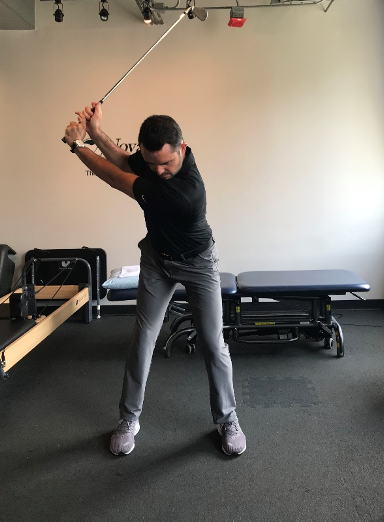
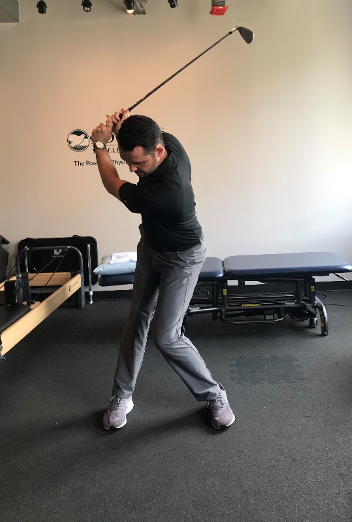
The
game of golf requires many different combinations of strength and flexibility,
including pelvic stability, thoracic rotation, lumbar to pelvic disassociation,
trunk and shoulder mobility, hip rotation and core strength. Common injuries
related to golf include low back pain, elbow injuries and knee pain.
Low Back Pain
Starting
with the most common injury complaint among golfers: low back pain. The
incidence of golf-related low back pain ranges from 15% to 34% among amateur
golfers and 22% to 24% among professional golfers. 1 A major role in
the incidence of low back pain is the lack of core stability during the golf
swing, lack of warmup prior to a round, loss of posture during the swing and
inadequate hip rotation during the swing. While golf is seen by many as a
leisure sport, professional golfers are now strength training more than ever to
combat sport-related injuries.
Below
are two stretches and two exercises to help alleviate low back pain:
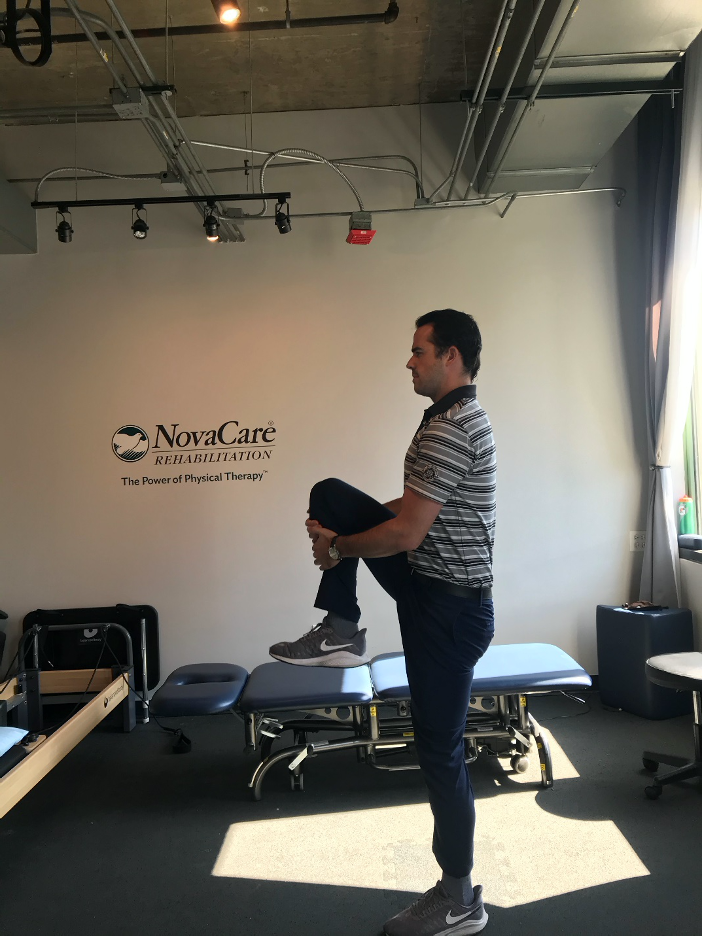
Knee to Chest While Walking
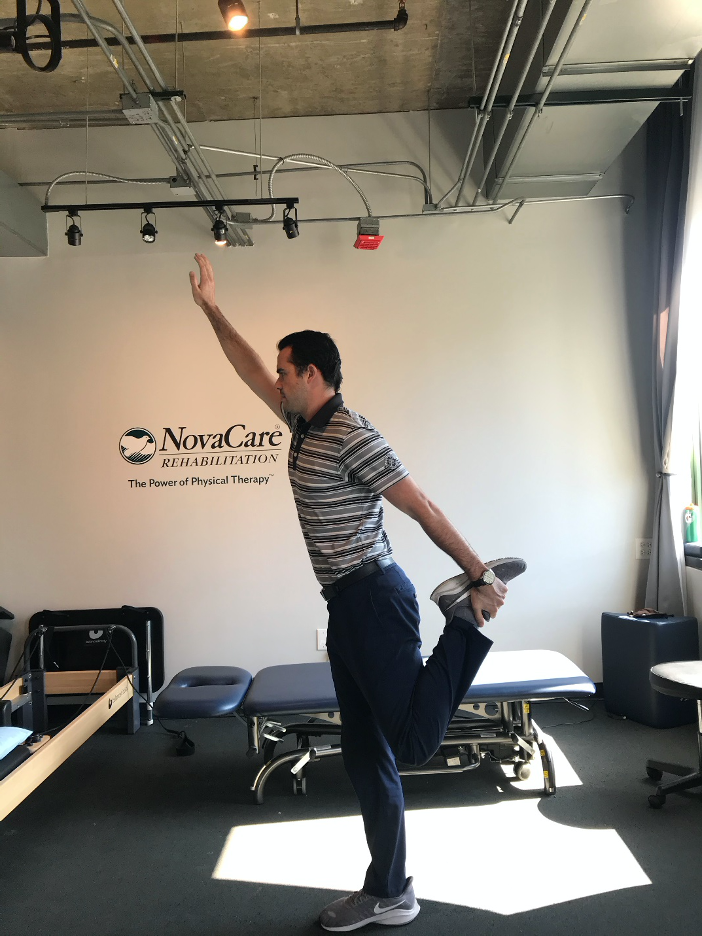
Standing Quadriceps Stretch
Pelvic Tilts
Lay on back with knees bent, feet flat on ground
Place hands on hips
Draw belly button towards spine and flatten back onto mat
Hold 2-3 seconds
Reset
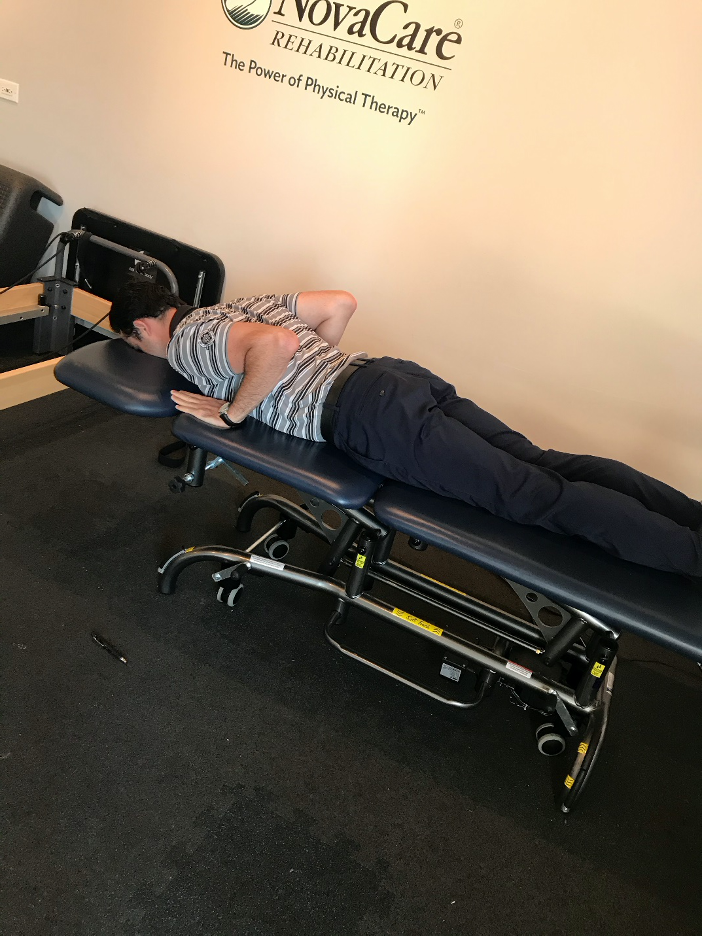
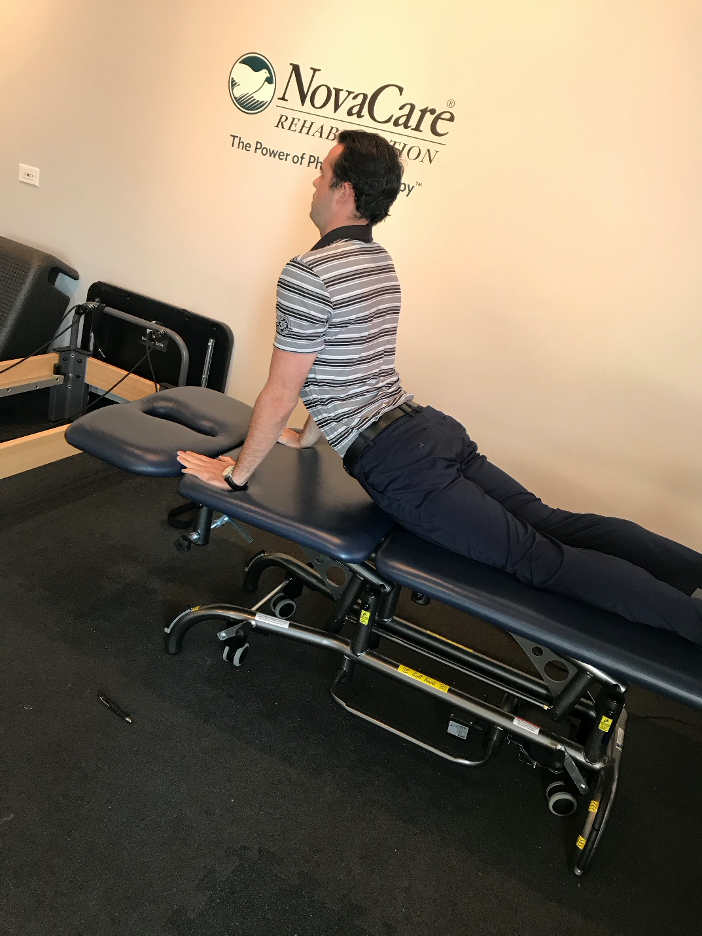
Prone Press-Ups
Lay face down
Place hands on mat by shoulders
Press into ground and begin to straighten elbows
Keep glutes relaxed as chest lifts off mat
Elbow Injuries
Elbow
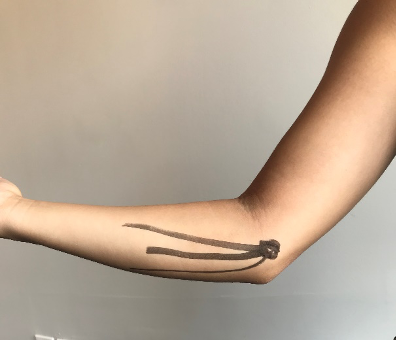
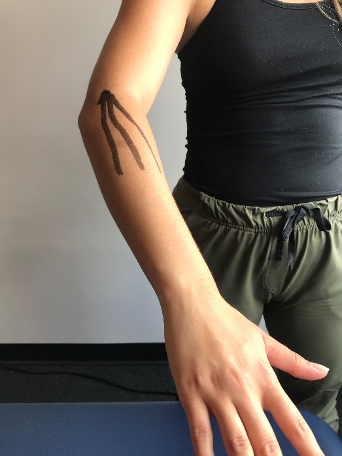
injuries are common in golf and tennis. Medial epicondylitis (also known as
Golfer’s elbow, Little Leaguer’s elbow or Thrower’s elbow) is an injury
occurring at the inner aspect of your elbow, while Lateral epicondylitis
(tennis elbow) is an injury occurring at the outer aspect of your elbow.
Medial
epicondylitis occurs when we “chunk” shots, hitting too much of the grass or
sand during our swing, whereas Lateral epicondylitis occurs when we use too
much of our right hand for right handed golfers. Elbow injuries most commonly occur
from a lack of upper back rotation (thoracic rotation), decreased shoulder
mobility and poor shoulder blade (scapular) stability.
The
stretches and exercise below will assist with the mobility needed for elbow injury
prevention:
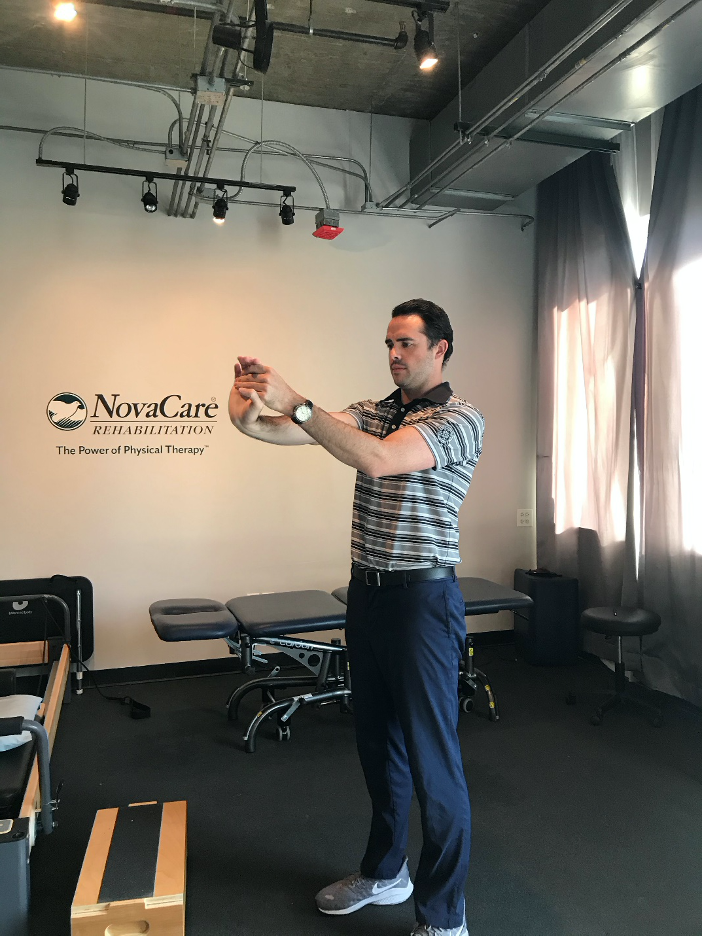
Wrist extensor stretch
Lift arm in front of chest palm down
Take other hand and gently press hand down bending at wrist
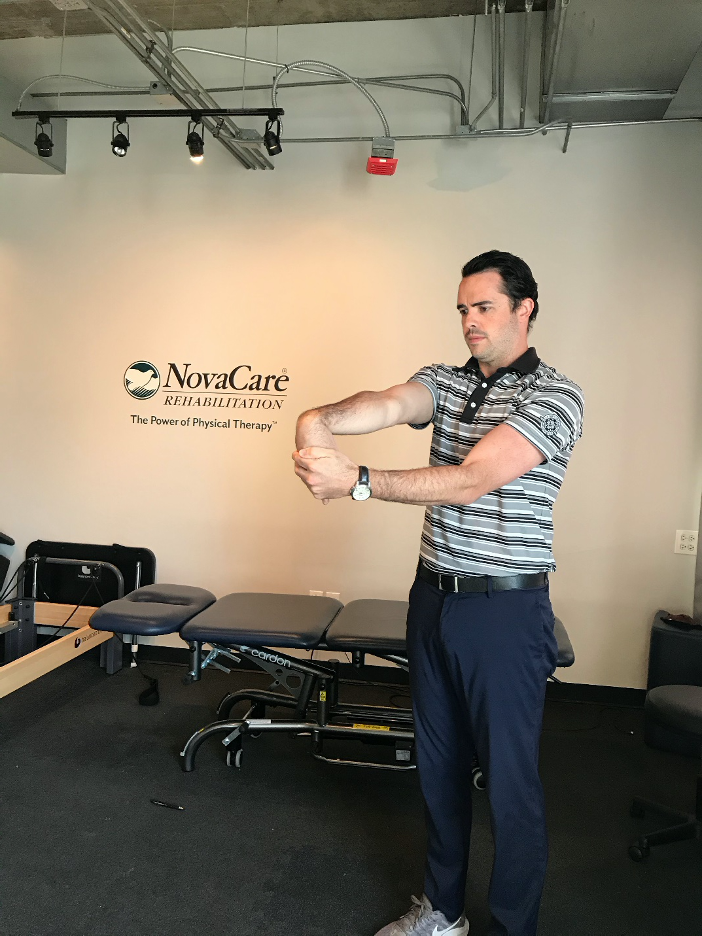
Wrist flexor stretch
Lift arm in front of chest, palm up
Take other hand and gently press hand down bending at wrist
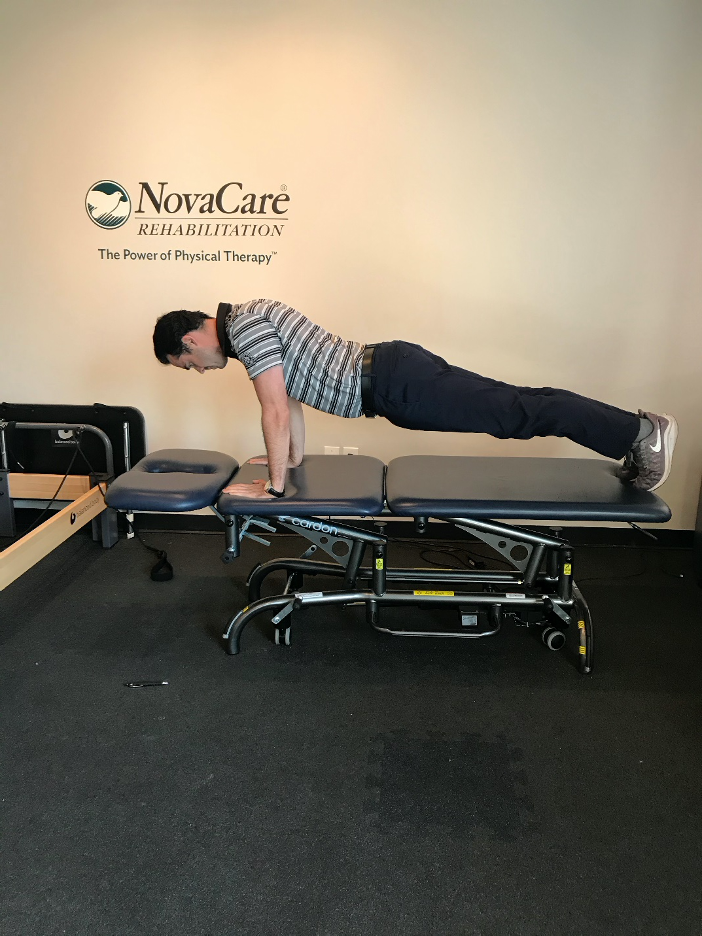
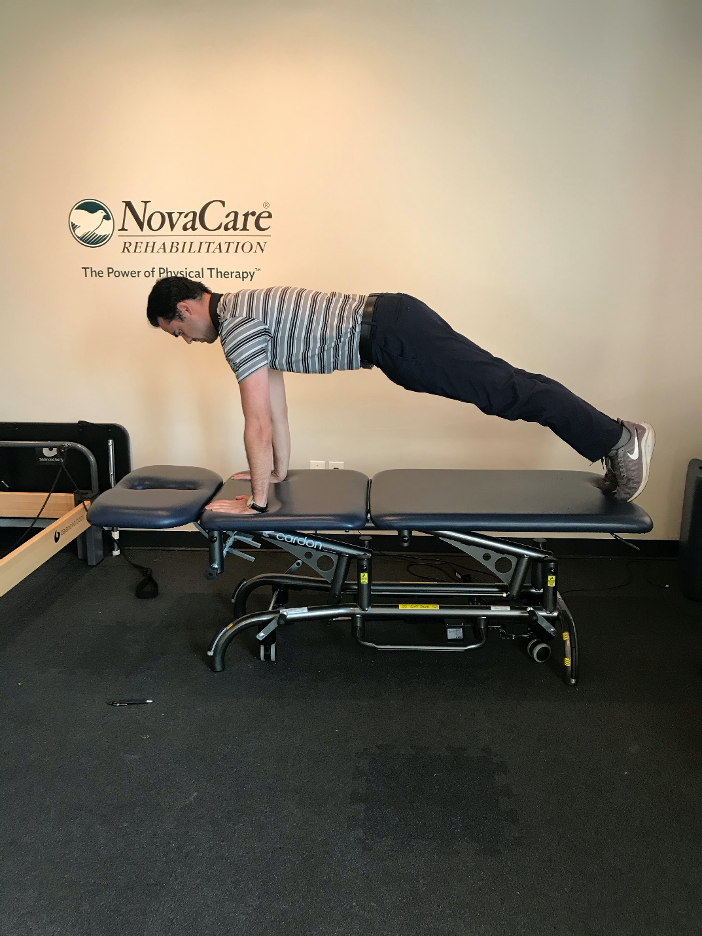
Press-Up Plus
Start at top of push-up position
Keep elbows straight while squeezing shoulder blades together
Push shoulder blades apart rounding the upper back
Knee Pain
A
2011 study on 504 individuals over the age of 50 revealed that 46.2% reported
having knee pain.2 In a golf swing, a lack of hip and/or trunk
rotation, pelvic stability and “over-swinging” can result in injuries to the
knee — most commonly, a meniscus tear. Formerly known as “tearing your
cartilage,” a meniscus tear occurs when the body is rotated over a bent knee
over a planted foot. The risk of injury increases as our trunk and hip rotation
decreases, compensating by having our lead knee bend in during the backswing
and bend out and rotate forcefully during our downswing and follow-through.
Force can be taken off the knee by improving our hip and trunk rotation, core
stability and increasing our gluteal strength.
If you
are experiencing knee pain or are looking to improve your rotation, core stability
and gluteal strength, check out the exercises below:
Hip abduction
Lay on side
Straighten top leg, bend bottom leg
Lift top leg
Keep toes pointed down towards ground
Book openers
Lay on side, knees stacked and bent
Stack arms in front of face
Slowly open top arm towards sky, following hand with eyes
Rotate chest open
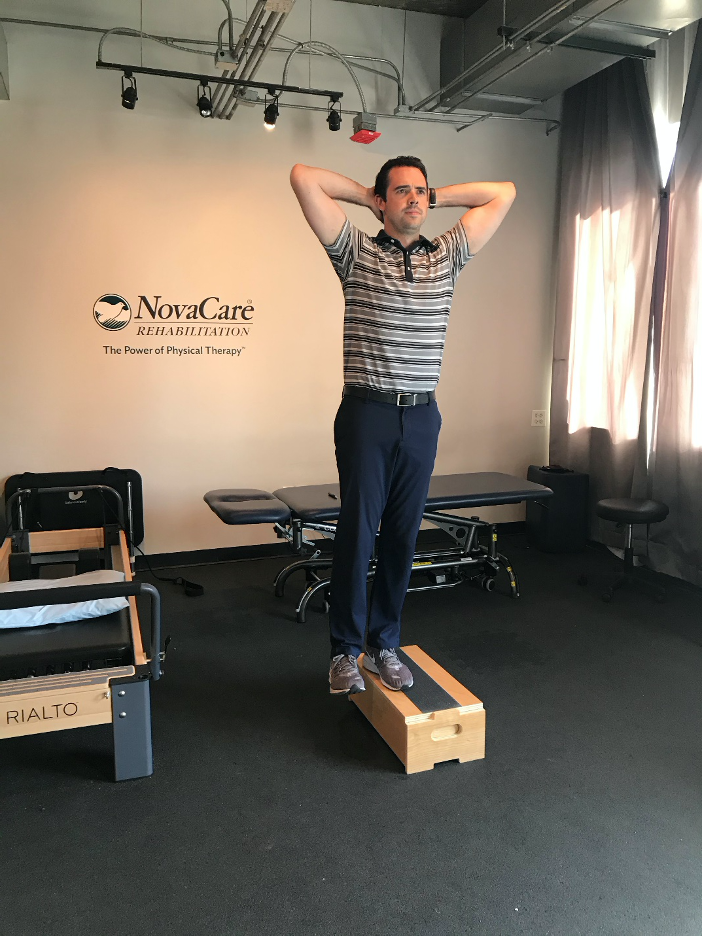
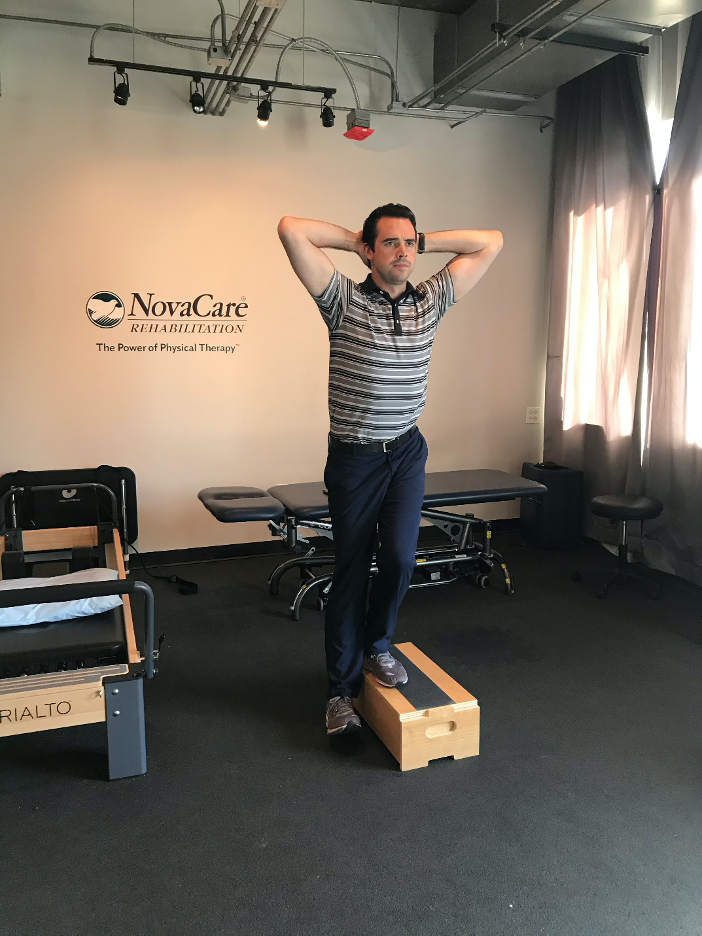
Lateral step downs
Stand on box or step with one foot
Keep weight through heel of standing leg as you tap other heel onto ground
As the knee bends make sure to keep knee in line with middle toes
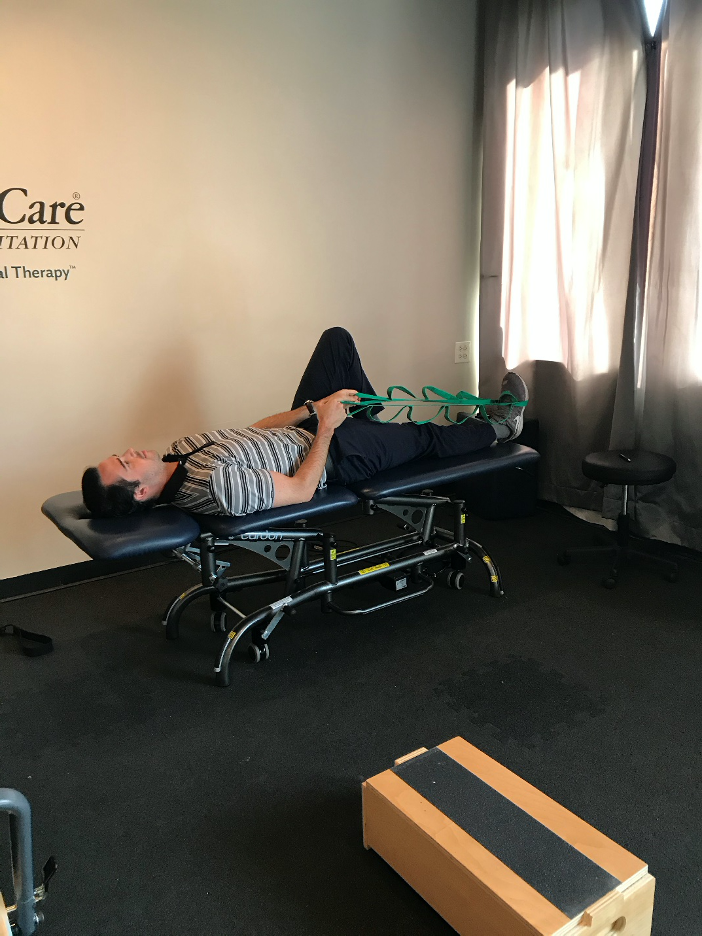
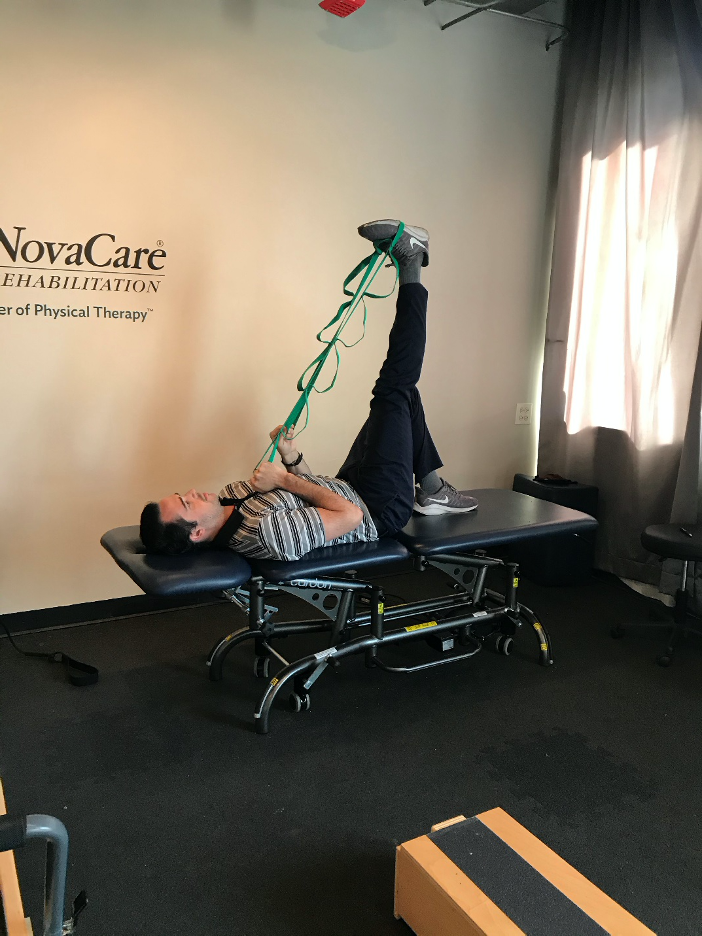
Hamstring stretch
Lay on back
Lift one leg towards face using strap or towel as assistance
Try to keep knee straight of lifted leg
Hold for 30-60 seconds
1. McHardy
AJ, Pollard HP, Luo K. Golf-related lower back injuries: an epidemiological
survey. J Chiropr Med. 2007;6(1):20-26.
doi:10.1016/j.jcme.2007.02.010
2. Nguyen US, Zhang Y, Zhu Y, Niu J, Zhang B, Felson DT. Increasing prevalence of knee pain and symptomatic knee osteoarthritis: survey and cohort data. Ann Intern Med. 2011;155(11):725-732.
Post written by FFC Contributor and NovaCare Gold Coast Physical Therapist Casey Gray.
Casey Gray is a physical therapist at NovaCare Rehabilitation inside FFC Gold Coast. He enjoys using his outgoing personality and positive attitude to optimize treatment of the entire individual. Casey recently graduated with his doctorate of physical therapy from University of Saint Mary, located outside of Kansas City, Kansas. Casey enjoys playing and watching sports like basketball, football, baseball, and golf.
https://dev.ffc.com/wp-content/uploads/2020/07/Calling-All-Golfers.jpg14402280Sydney MeyerSydney Meyer2020-07-07 13:09:382020-07-07 13:09:38Calling All Golfers: Try These Exercises To Prevent Or Treat Aches And Pains
On Monday, March 16, I taught my final in-person group fitness class before we closed our clubs due to COVID-19. An otherwise full studio was left to only four students and me. As local government officials put our shelter-in-place order into effect, it became apparent that we would not be re-opening the clubs any time soon. So, what’s next for someone like me?
I built my career on teaching group fitness classes to thousands of students over the course of 34 years. I have colleagues, peers and many friends who have done the same. Group fitness instructors are a very interesting, unique breed. The love of teaching is woven into our DNA; the number of people we reach in our classes can either make or break our day and when the music and energy in the room is at its best, so are we. Now all of that is gone. Where do we go from here?
Online services, whether academic, entertainment, social or work-related have been alive for a long time. In the fitness industry, there are so many services to choose from; you can take your workouts anywhere, with anyone at any time. With the closure of our clubs, it was time for me to jump into the wild world of streaming online classes. Those that know me would say I am definitely not a very tech savvy person, so I had some concern with my ability to get the logistics in place. Once all of that was worked out, I was ready to stream my first class on FFC’s Facebook page. I started with our signature all upper body workout, Amp’d Up, for the first few weeks simply because I was only three weeks into a total hip replacement, and I wanted to be sure I could deliver a class worthy of our viewers. I had a blast! It was so incredible to be able to do what I love, move to music and express myself in the way that only teaching group fitness can do.
As I continued to recover from surgery and my body was getting stronger, I started to add more robust signature formats to our FFC On Demand platform: LOADED, Chisel, Modern Mat, and of course, Formula 94. One of the things I am most proud of is our unique programming and format offerings at Fitness Formula Clubs. No matter your workout preferences or your fitness level, we have you covered. Having the opportunity to keep our FFC community connected and to come into the homes of people all over the world is an incredible honor.
Live streaming reminded me of why I love teaching: connecting with people, sharing my knowledge, watching people transform their bodies and build confidence (plus, it is so much fun). I took live streaming as an opportunity to polish my communication skills. When we are teaching to a camera, we are stripped of so many elements that exist when teaching students in the studio. Real time feedback is gone–of course we get some comments from viewers and a handful of heart emojis–but it cannot compare to the looks on people’s faces, the energy they bring to the workout and the motivation you get from being part of a community.
Group fitness pros are managing so many things during one single class: music and mic volumes, movement patterns, cueing, what we say and when we say it, keeping the energy in step with the format, navigating the spectrum of all the different abilities in the room and the list goes on. Teaching classes in our studios with students right in front of you is very different than streaming on virtual platforms, but for me my mission is unwavering. The physical space I teach in, the people I work with and the brand I represent can all change, but my mission for my work and my desire to elevate every person who takes my classes will never leave me.
Live streaming classes for me is a gift. It is my challenge to reach people in a very different way. It is never about likes and heart emojis. Coming into people’s homes where they feed their families, homeschool their kids and binge Netflix with the dogs takes on a very personal tone. Likewise, they get a peep into my living space as well, making this whole experience more intimate. During this time of great uncertainty, it becomes even more clear the value of my health. The purpose is not in achieving the best looking physique, but respecting my mental well-being and tapping into my intellectual and spiritual self.
I am looking forward to the day when we open our doors and we are all back together again in our studios across Chicago. Until then, I hope you hear me whispering in your ear “Shoulders back, chest out, chin up!”
Post written by FFC Contributor and Group Fitness Director Lois Miller.
https://dev.ffc.com/wp-content/uploads/2020/06/stream-on_-how-i-found-value-in-teaching-online-classes.png14002280Sydney MeyerSydney Meyer2020-06-09 09:35:162020-06-09 09:35:16Stream On: How I Found Value In Leading Classes Online
Technology has brought many wonderful things to our fingertips. However,
an undue side effect of all this technology and constant connectivity is a
condition a very large percentage of people suffer from known as “tech neck.”
In this day and age, so many suffer unnecessary neck pain and headaches due to
poor posture when using a computer, tablet or smartphone.
If you find yourself rubbing your neck, dealing with headaches or
feel frequent tension around your neck and shoulders throughout the workday, your
technology-using habits are likely a contributing factor. There are several
muscles around the back of your head and neck down to the shoulders — some are
bigger and some smaller — but any number of these can cause intense pain.
When we tilt our head forward, for example when using a
smartphone, the amount of pressure on these muscles multiplies tremendously. When
you sit up straight, the weight of your head is 10-12 pounds. When you slouch
and your head drops forward, the weight of your head can feel more like as much
as 50-60 pounds to your neck muscles, depending upon how far forward you
slouch. Imagine your muscles supporting as much as five times more weight for
several hours each day, and it’s not hard to understand why they’re hurting!
If you’re suffering from tech neck, the good news is that it’s
often reversible and very treatable. Here are five strengthening and stretching
exercises you can perform to combat this condition:
Chin Retraction
You might often find yourself sitting slouched forward with your head well in front of your shoulders. This is the starting position for retracting your head.
Pull your chin straight backward while looking directly forward. You should feel a “double-chin” forming under your jaw. Repeat 10 times forward/backward once every hour or two while working.
This can be performed while sitting at your work space and should be performed daily when working.
Trap Stretch
Everybody who works on a computer will develop tension in the upper trapezius muscles. This easy stretch can be performed at your desk any time, and you only need 20-30 seconds to help release tension on one side of your neck. If you want to stretch the right side, place your right hand on your waist or lower back, tilt your head to the left while looking back to the right. Place you left hand on top of your head and gently pull toward the left until you feel a comfortable stretch. You can hold as much as 20-60 seconds and repeat for the other side.
This can be performed while sitting at your work space and should be performed daily when working.
Thoracic Extension
Lean forward in your chair as if you’re smashing a pillow between your belly and thighs. Place your hands with fingers crossed behind your head.
Now reach your elbows toward the ceiling while you make sure to keep your belly close to your thighs, causing only your upper back to straighten. This reverses the forward bend and slouchy posture so many assume throughout the workday.
This can be performed while sitting at your work space and should be performed daily when working.
Prone Retraction
Lie face down on the floor with your arms at your side, hands near the hips.
Keep your neck straight (do not look upward) and simultaneously lift your chin, arms, and knees off the ground. Hold the position for 2-3 seconds and release to the floor. Repeat 10 times, 3 sets of 10 repetitions is best.
This exercise should be performed 2-3 days each week to promote strengthening of the muscles across the back of your neck, shoulders, and torso.
Prone Scaption
Lie face down on the floor with your arms reaching upward and slightly outward from your head.
Keep your neck straight and simultaneously lift your chin, arms, and knees off the ground. Hold the position for 2-3 seconds and release to the floor. Repeat 10 times, 3 sets of 10 repetitions is best.
This exercise emphasizes the lower trapezius muscle between your shoulder blades due to the overhead arm position.
This exercise should be performed 2-3 days each week to promote strengthening of the muscles across the back of your neck, shoulders, and torso.
BONUS info nugget: Sit up straight! It’s not that complicated but often forgotten that we need to maintain good posture when working on our computers or viewing our phones/tablets. Be sure your computer screen is elevated, at eye level is ideal. If you’re working on a laptop, this is less than ideal, but do your best to comfortably elevate the computer and you’ll have to direct your gaze downward while you keep an upright posture. If you’re on a phone/tablet, you’ll simply need to make a better effort to hold the device higher in front of your face.
Post written by FFC Contributor and NovaCare West Loop Clinical Manager Joe Zucco.
Joe Zucco graduated from the University of Missouri with a Master of Physical Therapy degree in 2002. He later completed a post-graduate residency program in physical therapy and earned his doctorate and fellowship credentials. He has lived and worked in Chicagoland since 2010 and has been clinic manager of the NovaCare West Loop location since 2016. He has undergone Graston training and also utilizes massage and release techniques. He is also experienced in Dry Needling which he also uses regularly in clinical treatments. Joe’s other manual therapy skills include joint mobilization and manipulation.
https://dev.ffc.com/wp-content/uploads/2020/05/Suffering-From-Neck-Pain_-Try-These-5-Stretches-Today.png14402280Sydney MeyerSydney Meyer2020-05-27 15:30:282020-05-27 15:30:28Suffering From Neck Pain? Try These 5 Activities Today
Having choices is wonderful. Having too many choices, however, can be paralyzing. The fitness industry was quick to adapt to at-home workouts and online classes, and here at FFC, we’ve been offering daily workout classes on our Facebook page and on our app, FFC On Demand.
While we’re proud of the 250+ classes now available on FFC On Demand, we understand how overwhelming it can be to choose a workout with that many options! If you’re having trouble deciding what your next sweat session should be, take a peek at our breakdown below for some guidance.
All of the classes below can be found in the Fitness section of FFC On Demand. Simply search for the class name and enjoy your workout! You can also filter classes by length, level and style to find workouts to meet your needs.
If you’re looking to start a new fitness routine, these classes are great for beginners:
Beginner Seated Chair Workout with Christine
Beginner Standing Chair Workout with Antoine
Yoga Basics with Brent
Fundamental Fitness with Cameron
Pilates Basics with Cameron
Have weights at home? Try one of these:
Kettlebell Workout with Sarah
Loaded with Austin
#312 with Kelly
Yoga Sculpt with Emily
Barre Bootcamp with Midnite
If you’re looking for low impact yet highly effective workouts, start with these:
Pilates Mat with Kristin
Strength and Mobility with Lara
FitCore with Lara
Yoga For Athletes with David
Amp’d Up with Lois
Want to know what classes other members are watching? These are the most popular classes on FFC On Demand:
Total Body Blast with Austin
WERQ with Jen
Motiv8 with Becca
30 Minute Workout with Brian
Sunrise Yoga with Elissa
Ready to take a live class? These classes are currently offered weekly on FFC On Demand:
Mondays at 9 AM: Formula 94 with Lois
Tuesdays at 12 PM: Modern Mat with Lois
Tuesdays at 1 PM: Spinning Interval with Daniela
Wednesdays at 12 PM: Loaded with Austin
Wednesdays at 6:15 PM: Yoga For Athletes with Tom
Thursdays at 9 AM: Chisel with Lois
Fridays at 5:15 PM: Formula 94 with Mari
For instructions on how to register for these live classes and to see the most up-to-date schedule, please head to ffc.com/schedule.
Post written by FFC Contributor Natalie Casper.
https://dev.ffc.com/wp-content/uploads/2020/05/How-To-Find-The-Perfect-Workout-For-You-On-FFC-On-Demand.png14002280Sydney MeyerSydney Meyer2020-05-22 10:34:062020-05-22 10:34:06How To Find The Perfect Workout For You On FFC On Demand
Looking for safe but effective exercises to perform at home during your pregnancy? NovaCare Rehabilitation physical therapist Emily Grimm is sharing her favorite exercise routine that can be completed without any equipment from the comfort of your home.
Evidence shows that long-term physical activity during pregnancy can deliver positive outcomes on maternal health, labor, birth and postnatal infant health. Pregnant women who engage in regular exercise using large anti-gravity muscle groups have been shown to have shorter labors, decreased risk of preterm birth or Cesarean section surgeries; even the fetal heart rate responds positively to exercise longer than 10 minutes in duration.
Before we get to our list of exercises, we want to make you aware of some general movements to avoid while exercising during your pregnancy:
Jerky, bouncy movements
Abdominal compression
Inversions
Prolonged time laying on your back
Straining the abdominals or pelvic floor
Vigorous stretching of your adductors
Extreme asymmetrical lower limb positions (some yoga poses should be avoided)
The at-home exercises listed in this article require minimal or no equipment and will keep your core and pelvic floor muscles strong. These movements can even help reduce some pregnancy-related pain in the lower back, pelvic girdle or hips. These exercises can be a great addition to other light activities like walking and jogging (if comfortable).
As with any exercise regimen, please listen to your body at all times, and do not proceed if you feel pain or discomfort with any exercise.
Start by performing 2-3 sets of 10 reps of the exercises below 2-3 times per week. Emily’s pro tip: to perform a pelvic floor contraction during these exercises, think “holding in the flow of urine then pulling upwards towards your belly button.”
Bridge with Abduction
Place a band around your knees (if you have one), tuck your pelvis as if to flatten your lower back against the floor, squeeze your gluteal muscles and bridge up slightly pushing your knees outward against the band. Hold for 5 seconds and repeat.
Bridge with Adduction
Place a pillow between your knees. Tuck your pelvis as if to flatten your lower back against the ground, squeeze your gluteals and lift up gently pushing knees into the pillow. Hold for 5 seconds and repeat.
Bird/Dog
Start on hands and knees. Engage your abdominals by pulling in toward your spine (as best you can, difficult to do while pregnant!). Raise your opposite arm and leg, holding 2-3 seconds, then switch.
Clams
Lay on your side, place a band around your knees (not required). Keeping your hips stacked, lift your top knee up to rotate your hip out. Repeat movement.
Plank Progression
Try planks against the wall to begin (depending on your tolerance, fitness level, comfort). Make sure to engage your core by pulling your abdomen towards your spine and attempting to perform a pelvic floor contraction. Make sure to breathe. Start with 15 second holds, progressing to 30 seconds, 1 minute as tolerated.
Corrective DRA Curl Up
This exercise is best to perform early in pregnancy or post-partum to reduce abdominal separation.
Place hands on both sides of abdomen gently applying pressure toward your belly button. Perform a pelvic floor contraction, draw abdomen in down toward your spine and curl up as you exhale. Hold 10 seconds, progress toward 30 seconds.
Have a question for Emily or looking for further explanation on these exercises? Give her a call at NovaCare: 773-281-4220. Emily is available for virtual and in-person consults for your needs during this time.
Post written by FFC Contributor and NovaCare Rehabilitation Physical Therapist Emily Grimm.
Emily Grimm is a Doctor of Physical Therapy and Center Manager at NovaCare Rehabilitation in Lakeview. She is an Obstetrics Specialist who enjoys working with pregnant and post-partum women who may be experiencing pain, preparing for or recovering from birth, or looking to maintain or return to a healthy fitness routine. She is also a Certified Manual Therapist with success in treating various other orthopedic conditions.
https://dev.ffc.com/wp-content/uploads/2020/05/Our-6-Favorite-At-Home-Exercises-For-Pregnant-Women.png14002280Sydney MeyerSydney Meyer2020-05-13 13:40:182020-05-13 13:40:18Our 6 Favorite At-Home Exercises For Pregnant Women
This simple recipe is a healthy, vegan twist on a classic summer favorite. Traditionally made with bacon and cider vinegar, this plant-based version gets bold flavor from smoked salt and spicy brown mustard. Serve this side dish for a gluten-free side that everyone will love.
Ingredients
3 pounds Yukon Gold potatoes, cut into ½-inch thick disks
¼ cup apple cider vinegar
4 teaspoons spicy brown mustard
½ red onion, diced
1 teaspoon smoked salt
¼ teaspoon ground black pepper
¼ cup water (use the water from boiling the potatoes)
Place the potatoes in a medium pot and cover with a couple of inches of water. Cover, bring to a boil, and reduce to simmer. Simmer until knife-glide tender, about 6-8 minutes. Because the potatoes are thinly sliced, keep an eye on them – it won’t take them long to be done.
To make the healthy vegan german potato salad:
While the potatoes simmer, prepare the other ingredients for the salad. In a large bowl, combine the cider vinegar, spicy brown mustard, red onion, smoked salt, and black pepper. Toss well to combine. After the potatoes have simmered for a few minutes (and have started to release some of their starches), portion out ¼ cup of the water. Add this to the bowl with the dressing ingredients.
When the potatoes are done simmering, remove from the heat, and drain well. Immediately add them to the bowl with the dressing ingredients. Toss well to combine. Taste to adjust seasoning.
Post written by FFC group fitness instructor Katie Simmons. Some photos provided by Katie Simmons.
More about Katie: Katie is a group fitness instructor at FFC and is also a personal chef based in Chicago. She specializes in creating delicious, healthy recipes for those with special dietary concerns like gluten-free, oil-free, plant-based, and low-residue. You can see more at www.plants-rule.com. You can also see more recipes at www.facebook.com/plants-rule and follow her on Instagram at @chefkatiesimmons.
https://dev.ffc.com/wp-content/uploads/2020/04/Healthy-Vegan-German-Potato-Salad.png14002280Sydney MeyerSydney Meyer2020-04-23 08:00:492020-04-23 08:00:49Healthy Vegan German Potato Salad
While we are confined to our homes, we may find ourselves resorting to new forms of exercise as we develop a fitness routine outside the gym. Bodyweight workouts, running and yoga all come with their own sets of aches and pains, so we asked NovaCare Rehabilitation physical therapist Katie Wax to share her favorite stretches to alleviate soreness and discomfort from at-home workouts.
Before we move on to the stretches, we want to remind you that a proper warm up before your sweat session is key to injury prevention. The last thing you want is to return to the gym with a new injury!
The stretches listed below are to be completed at the conclusion of your workout in order to lengthen muscles that tend to shorten or contract during bodyweight exercises like push ups, planks, squats, lunges and running. Each stretch should be held for at least 30 seconds (this allows adequate time for tissue fibers to actually lengthen) and should be performed 3 times each. The stretches should not be painful.
Pectoralis Stretch or “Doorway Stretch”
The pectoralis stretch helps open up the shoulders after sitting in front of the laptop all day or knocking out lots of push-ups.
To perform the stretch: Find a corner or doorway. Place arms against the wall and gently lean forward until a stretch is felt in front of the chest. You can change how the stretch feels by raising or lowering your arms on the wall to stretch different muscle fibers.
Wrist Flexor Stretch
The wrist flexor stretch is useful after any type of weight-bearing exercise through the arms, like those found in yoga or exercises in plank position.
To perform the stretch: Place the backs of the hands up against each other. The stretch should be felt across tops of wrists and across the forearms.
Calf Stretch
It’s important to stretch out your calves after any jumping exercises found in HIIT classes or after jogging or walking.
To perform the stretch: Stand with the leg you intend to stretch behind you and bend your front knee. While keeping your back leg straight and heel on the ground, gently lean forward. Toes should be pointed forward. The stretch should be felt in the lower posterior aspect of hind leg.
Kneeling Hip Flexor Stretch
The kneeling hip flexor stretch is perfect following a run due to the repetitive hip flexion that occurs. This stretch also helps prevent tightness in the hips from prolonged periods of sitting.
Starting position:
Get into a half kneeling position. Prior to leaning forward, rotate the pelvis posteriorly (or tuck your tailbone).
Ending position:
Keeping your hips square, gently shift your weight forward. Be careful not to bend the knee past your toes. The stretch should be felt in front of the hip on the back leg.
Piriformis Stretch
Feeling glute tightness after squatting or lunging? The piriformis stretch will combat that!
Starting position:
Lie on the floor with your knees bent. Cross one leg over the other so that the ankle is resting on the opposite thigh.
Ending position:
Pull the thigh of the uncrossed leg toward your chest. You should feel a stretch in the gluteal region of the leg that is crossed.
Have a question for Katie or looking for further explanation on these stretches? Give her a call at NovaCare inside FFC East Lakeview: 773-248-3401. Katie is available for virtual and in-person consults for your needs during this time.
Post written by FFC Contributor and NovaCare Rehabilitation Physical Therapist Katie Wax.
Katie Wax (PT, DPT, CMPT) is a physical therapist for NovaCare Rehabilitation’s East Lakeview location. She takes a holistic and active approach to patient care. Katie understands that each patient has their own lifestyle and prepares a plan of care specific to each patient that is evaluated. Katie enjoys working out and running the lakefront, while balancing her time with her family. She is also an active participant in the Chicago community.
https://dev.ffc.com/wp-content/uploads/2020/04/Sore-From-Your-At-Home-Workouts.png14002280Sydney MeyerSydney Meyer2020-04-21 15:39:572020-04-21 15:39:57Sore From Your At-Home Workout? Try These Physical Therapist-Approved Stretches
As a technology and fitness professional, I have the pleasure of seeing two different worlds. On one end, I see the rapid rate of my Outlook inbox filling with email requests. On the other, I’m reading body language for proper form and signs of muscle fatigue. What’s interesting is how much these worlds can benefit from each other. I’ll give you an example from each side so it doesn’t seem like I am biased.
Technology: If I had a dollar for every time someone told me “I don’t have time to work out,” I would be retired. What I’ve learned since incorporating a health and wellness practice is that my productivity at work has sky rocketed. I’m able to do more with less without breaking a sweat (no pun intended) because my mind and body are optimized before logging into work.
Fitness: One of the first questions I ask my clients and the people closest to me is, “How did you sleep?” Most people respond with “Fine,” but how do we really know? There are many technology companies in the market that will track sleep, but based on feedback from clients, it’s either they don’t want to wear a device, don’t want to know the real answer or don’t care. Leveraging technology that will measure your specific metrics can tell you how ready your body truly is for that specific day.
As we wrap up week four of isolation, I’ve noticed that clients of mine have either accepted this “new normal” or have fallen off the band wagon of their fitness routine. We don’t know if another three weeks will be the end of isolation, but what I do know is that this is a new week to change it up.
I am an advocate for volume based training. Volume can be defined as repetitions (reps) multiplied by sets. With that being said, if you’re cramming too many reps and sets in a constrained time window, you’re setting yourself up for an injury. I have recently implemented a change in my fitness routine where I break up my long workout into three smaller sessions throughout the day.
High Level Overview: • Morning – Light Cardio, Core, and Mobility (20 – 40 minutes) • Afternoon – Strength Training (30 – 40 minutes) • Evening – Yoga and Meditation (5 – 10 minutes)
Morning:
I am firm believer that the way you start your day will impact the rest of your day. The beauty of being a fitness professional who is also in corporate America is that I know the cognitive benefits of a morning workout. I recently read the book Make Your Bed, where I found connections to my morning routine. One of the messages from the book was that by making your bed first thing in the morning, you gave yourself the satisfaction of already accomplishing something that day. For me, fitness has become that morning ritual. When I complete my morning session I have accomplished something and am ready to take on corporate America. It not only prepares my body but my mind to think clearer, sharper and be fully optimized.
As for a workout, I believe in leveraging the morning to wake up the body and soul. I do this with mobility work and a light run outside while the sun is rising. For non-runners, you can go for a walk or bike ride outside to begin the day. This will promote blood flow throughout your body and naturally elevate your heart. Not to mention, if you’re doing this as the sun rises or after the sun rises, you’re taking in Vitamin D, which is highly recommended by the CDC right now.
I’ll follow up my cardio session with core exercises to stimulate the muscles in my torso. I’ll push for 4 different kinds of exercises focused on each area of the core (Rectus Abdominus, External Obliques, and Erector Spinae). Once completed, I’ll head to the shower and begin my day job in the technology world.
Afternoon:
There are numerous studies that have proven that taking breaks throughout your day will optimize your productivity. We all know that person who doesn’t believe in breaks and may receive a high five for self discipline, but I like to lean on the side of science. Implementing a short workout in the middle of work will not only break up your day, but redistribute blood flow from sitting all day.
I feel like there is a false perception around working out in that you need to do all of this preparation and put high strain on the body in order for it to be called a “workout.” That simply is not the case, and there are many options for re-awakening the body without having to drink your sixth cup of coffee for the day.
Whether you have a home gym, kids or neither, you can still find a way to redistribute blood flow and activate those muscles. If you’re fortunate enough to have a home gym, I recommend 3 – 4 sets of exercises focused on the lower or upper extremities depending on the day. You could also do a circuit based session which can hit all areas of the body.
If you have children, I recommend going outside with them and playing a game. You could view this as recess time, and you also get additional family time which you normally wouldn’t have from working in the office. If you don’t have a gym or kids, you can go to resources like FFC On Demand to give you bodyweight workouts.
Evening:
To wrap up the day, I focus on minimizing distractions such as TV, social media or email. Studies have shown that blue light from screens delay the production of natural melatonin. Melatonin is generated within the pineal gland that signals to the body when it’s time to go to sleep. If you’re in bed with a laptop or device, you may not be getting the sleep your body needs in order to be ready for the next day.
This is an area I feel most members of corporate America don’t think about but could benefit from tremendously. The reason why this is important for corporate America is because of a type of sleep called rapid eye movement (REM) sleep. The best way to think of REM sleep is your dream sleep. One of the main benefits of REM sleep is that it’s the mind’s way of refreshing for the next day. It can viewed as the memory consolidation phase of sleep so your brain is more cognitive for the next day.
As it pertains to fitness, I take this time to down regulate my body and soul. I do this with yoga and finish with meditation. For me, I will leverage yoga as time to focus on static stretching to help with muscular recovery. I tend to focus a lot on my lower back, hip flexors, and shoulders. These are commonly tight areas for corporate America as we sit at a desk and lean into the computer screen. From a soul perspective, I will do transcendental meditation which is meditation in silence. I’ve found this works best for me as the day is full of noise.
Final Thought:
Fitness is not only a way to build muscle but also a way to provide structure in your day. It gives purpose to a dedicated time. We can’t control how long we are told to stay at home, but we can make the best of it. I encourage everyone to find what works for them and make the best of this “new normal.”
Post written by FFC Contributor Omar Romero.
Omar is a fitness enthusiast based out of the Chicagoland area. As an FFC group fitness instructor, his focus is around functional fitness mixed with high intensity interval training. His personal philosophy is based on hard work and no excuses. For more information, tips and articles from Omar, visit his website: OmarRomero.com.
https://dev.ffc.com/wp-content/uploads/2020/04/Breaking-Up-Your-Daily-Fitness.png14002280Sydney MeyerSydney Meyer2020-04-17 10:39:242020-04-17 10:39:24Breaking Up Your Daily Fitness